Wormwood tarragon
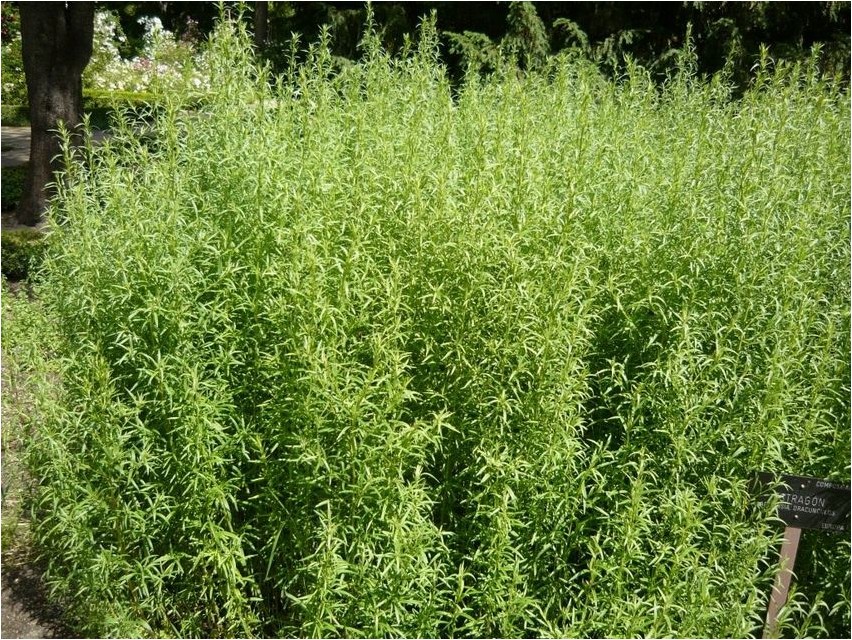
Artemisia tarragon is one of the plants of the family called Asteraceae or Asteraceae; in Latin the name of this plant will be as follows: Artemisia dracuncus L.
As for the name of the tarragon wormwood family itself, in Latin it will be: Asteraceae Dumort. (Compositae Giseke).
Description of tarragon wormwood
Wormwood tarragon is known by the following popular names: serpentine, tarragon, dragoon grass, trade, chagyr, ostrogon and allspice. Wormwood tarragon is a perennial herbaceous plant whose height will vary between thirty and one hundred and twenty-five centimeters. Such a plant is endowed with a branching woody rhizome, the thickness of which will be equal to half a centimeter to one and a half centimeters. The rhizome of this plant is covered with sparse root lobes. The entire plant will be bare; when young it can sometimes be pubescent, and it is colored green. The stems of tarragon wormwood are ribbed, few and erect, while in the middle and upper parts such stems will be branched. The leaves of this plant will be linear-lanceolate and entire, their length is about two to six centimeters and their width is seven to eight millimeters. Tarragon wormwood flowers are whitish in color and will be in spherical drooping baskets, which will be numerous and rather small in length, and also collected in a narrow paniculate inflorescence. The involucre of Tarragon wormwood heads is smooth and the outer leaves will be oblong, while the inner leaves have a wide membranous edge and are round-oval in shape.
Under natural conditions, this plant is found in the Caucasus, the Siberian Arctic, steppe and forest-steppe regions of Ukraine, the Far East, Crimea, Western and Eastern Siberia, as well as the European part of Russia.
Description of the medicinal properties of tarragon wormwood
Tarragon wormwood is endowed with very valuable healing properties, and it is recommended to use the herb of this plant for medicinal purposes. The concept of grass includes leaves, inflorescences and stems.
The presence of such valuable healing properties should be explained by the content of rutin, carotene, flavonoids, essential oil, vitamin C, beta-sitosterol, alkaloids, coumarins, sesquiterpenoids, phenolcarboxylic acids and their derivatives in this plant. The aerial part of tarragon wormwood will, in turn, contain essential oil, which is also present in the roots.

As for traditional medicine, here this plant is quite widespread. Traditional medicine recommends using tarragon wormwood for burns, eczema and scabies.
For gingivitis and stomatitis, you should use an ointment with butter from the powder of the herb of this plant. When mixed with pomegranate flowers, this plant is used for gingivitis and stomatitis.
An infusion or powder prepared from the roots of tarragon wormwood is recommended for use topically for various diseases of the oral mucosa. An ointment with honey based on this plant is used as a remedy that has the ability to enhance potency. It should be noted that as part of the preparations, such a plant is indicated for use in diseases of the nose that will be accompanied by a violation of the sense of smell.
An infusion prepared from the herb tarragon wormwood is recommended for use as an antipyretic and laxative. The herb-based tincture is used as an anthelmintic and tonic, and is also used as a diuretic for cystitis.





