Oleander
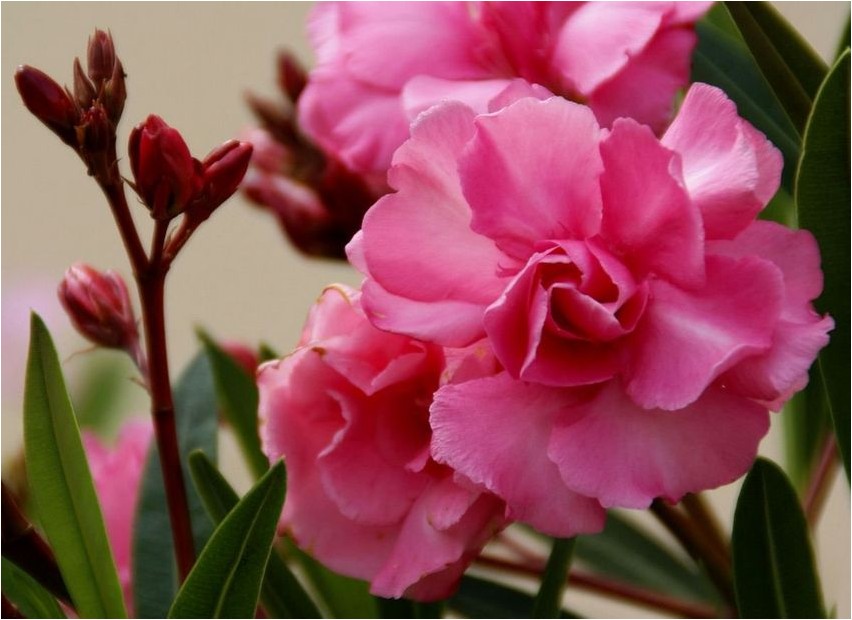
Oleander (lat. Nerium) is a genus of plants classified by botanists as belonging to the Kutrovaceae family, and includes a single species called “Common Oleander,” which in Latin sounds like “Nerium oleander.”
This is a branched shrub that blooms profusely with large inflorescences if it is provided with a sunny place to live. Breeders have worked hard and created more than 100 varieties of a single species, differing in flower shape and having a rich variety of colors of large and delicate petals. But the beauty of the shrub is combined with the high toxicity of all parts of the plant. Therefore, having planted such a shrub in your summer cottage or in a flower pot in a living room, you should handle it very carefully.
Description
Since in the wild the common Oleander chooses dry and sunny places to live, in order to sufficiently supply its above-ground parts with water it has developed a powerful root system consisting of a main short tap root overgrown with numerous adventitious hairy roots. They appear shaggy because they are also overgrown with thin roots.
Flexible stems branch in large numbers from the gray-brown trunk of the shrub, covered with relatively long and narrow dark green leaves. This leaf shape is called “lanceolate” in botany. The dark surface of the leaf is divided in half by a longitudinal light vein, as if it wants to enhance the green color with its contrast. The leaves are hard to the touch, like many tropical plants, with a smooth edge. Although the appearance of an individual leaf is quite simple, together they turn the common Oleander bush into a quite ornamental plant.
But there is one huge disadvantage of the leaves — their high toxicity. Experts say that one such leaf, accidentally falling into a vegetable salad, can lead to tragedy. Particular care must be taken if the common Oleander with its far extraordinary abilities grows within the reach of small children who get to know the world around them, tasting everything they encounter along the way.
Despite the decorative nature of the leaves, the main decoration of the shrub is its large flowers, which are collected into lush inflorescences for greater effect. The creator gave Oleander two colors to color its delicate petals: white and the most delicate pink. It seemed to the man that he had skimped on paints, and therefore he developed new varieties of plants, adding yellow and red, and possibly other colors, to the palette.

Naturally created oleander flowers are hermaphrodites, meaning they possess both male and female characteristics. Their five petals are arranged in a single plane. Humans have also contributed to this, creating lush, double flowers. But for their beauty, they have lost their reproductive organs, becoming completely sterile and wilting before they reach the fruit stage. To increase the number of such individuals, cuttings and layering are used.
Simple oleander flowers, pollinated by tireless insects, offer the species a chance to survive on Earth, transforming into long fruits (up to 10 cm long), containing curious seeds equipped with feathery tufts for free flight in search of a place where life can be reborn. Growing and Care
If you live in an area where winter temperatures don”t drop below minus 10 degrees Celsius, breeders have developed varieties suitable for these conditions. If winters are much harsher, a large flowerpot, tub, or greenhouse is more suitable for oleander.
The plant tolerates pruning well, so its natural desire to grow to a height of 2 meters can be successfully curbed, achieving abundant and long-lasting blooms.
An important factor when growing common oleander is its sun preference. If sunlight is insufficient, abundant blooms may never occur.
The soil under the plant should be loose, permeable, fertile, and moist, but not waterlogged.
Oleander. Propagation, Planting, Care Instructions





