Syrian hibiscus
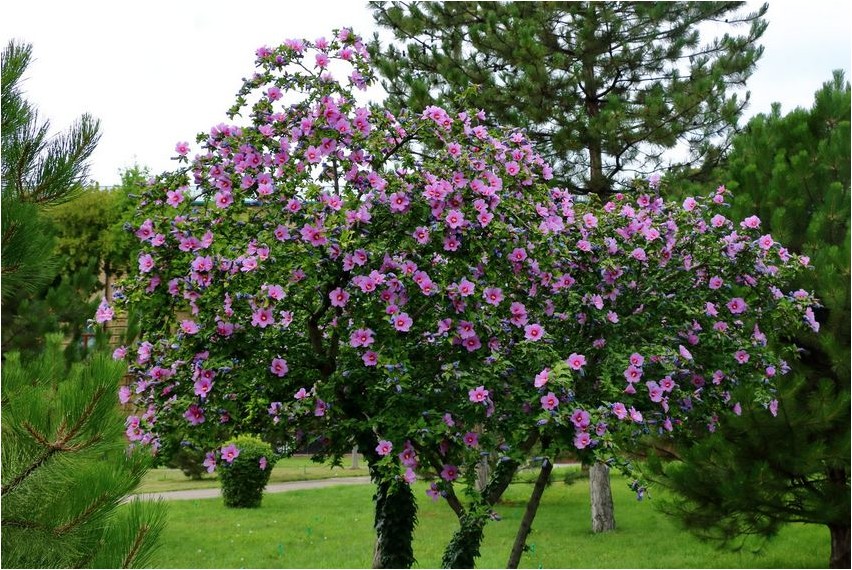
Syrian hibiscus is also known under the same name as ketmia and Syrian rose. In Latin, the name of this plant will be as follows: Hibiscus syriacus.
Syrian hibiscus is one of the plants of the family called malvaceae, in Latin the name of this family will be: Malvaceae.
Description of Syrian hibiscus
For the favorable development of this plant, it is recommended to provide moderate watering throughout the summer, and air humidity should be kept at an average level. As for the light mode, both sunny mode and partial shade are acceptable. The life form of Syrian hibiscus is a deciduous shrub.
This plant is very often found indoors, as well as in general purpose premises. In this case, it is recommended to place the pot with the plant in spacious and bright rooms. In the south, this plant is quite often grown in open ground; it is noteworthy that Syrian hibiscus can withstand temperatures dropping to about twenty-two degrees. As for the northern regions, the plant can be grown in glassed loggias, as well as in cold winter gardens. The maximum size in cultivation under natural conditions will be about six meters, but in indoor conditions this plant will be about two to three meters.
Description of the features of growing and caring for Syrian hibiscus
It is noteworthy that for the favorable development of Syrian hibiscus, it will be necessary to perform an annual replantation, which applies exclusively to young plants whose age will not exceed three years. Mature plants should only be replanted as needed. In each case, you should choose larger pots. It should be noted that it is quite acceptable not to use transplants, but in this case it will be necessary to replace the top layer of soil every year by about ten to fifteen centimeters. As for the composition of the soil mixture, you will need to mix four parts of turf soil, one part of sand and six parts of leaf soil. The acidity of such soil can be either neutral or slightly acidic.
It’s important to remember that if the plant receives insufficient light, its flowering will be very weak. Hibiscus syriacus flower buds may fall off if the substrate remains dry for a long time, although a sudden change in growing conditions can also cause similar adverse effects. It’s also important to remember that a sudden drop in temperature and excessive soil moisture can cause damage to this plant from gray mold.

During the entire dormant period, maintain a temperature between ten and fifteen degrees Celsius. Water syriacus hyrax moderately, and maintain moderate humidity. It’s worth noting that a dormant period is necessary when the plant is grown indoors. This dormant period occurs due to low humidity and insufficient light.
This plant is most often propagated by rooting one-year-old, semi-woody shoots. Experts recommend taking these measures in July or August. Air layering can also be used for propagation. Seed propagation is also extremely rare.
If you want to ensure abundant and beautiful reproduction of your Syrian hibiscus, you’ll need to fertilize the plant with fertilizers high in phosphorus. For example, monopotassium phosphate is ideal.