Sinningia grayish
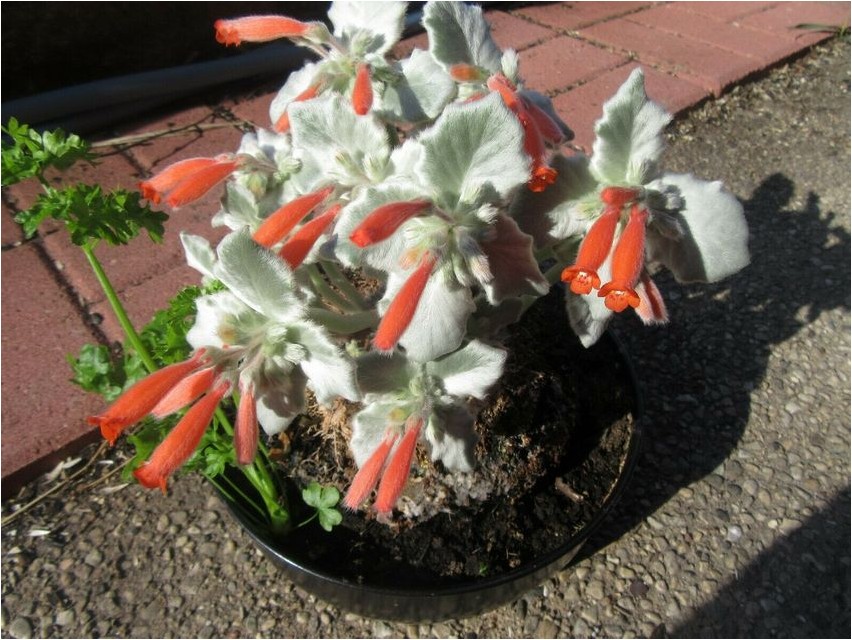
Sinningia greyish is also known as Reichsteineria alba. In Latin, the name of this plant will be as follows: Rechsteineria leucotricha.
Sinningia greyish is one of the plants of the family called Gesneriaceae; in Latin the name of this family will be: Gesneriaceae.
Description of Sinningia greyish
For the favorable development of this plant, it will be necessary to provide a sunny light regime, while partial shade is also acceptable. As for the features of watering in the summer, the plant should be watered moderately, and it is recommended to maintain air humidity at an average level. The life form of Sinningia greyish is a corm plant.
This plant can often be found both in winter gardens and in numerous warm greenhouses. As for growing gray Sinningia in indoor conditions, it is recommended to keep the plant in indoor greenhouses or in display windows. The maximum size in culture will be about fifty centimeters in height.
Description of the features of care and cultivation of greyish Sinningia
For the favorable development of this plant, regular replanting plays a very important role. It is recommended to replant gray-haired Sinningia into new soil after the end of the dormant period, which usually occurs at the end of February. In this case, the tubers of this plant should be replanted. As for the composition of the soil mixture itself, you will need to mix three parts of leaf soil, one part of peat and two parts of leaf soil. The acidity of such soil can be either slightly acidic or neutral.
It should be noted that it is important to always keep the soil in a moderately moist state, while both overdrying and excessive moisture are extremely undesirable. It is important to note that for the favorable development of gray-haired Sinningia, it will be necessary to maintain a temperature regime of at least twenty degrees Celsius. When there is an excess of nitrogen in fertilizing, root rot may occur in the peat substrate. In some cases, gray Sinningia can be affected by spider mites and aphids.

Throughout the entire rest period, it is necessary to ensure optimal temperature conditions, ranging from thirteen to fifteen degrees Celsius. The occurrence of such a period of rest is forced and occurs due to insufficient lighting and low air humidity. However, such a dormant period occurs when kept in an indoor greenhouse. The dormant period of gray-haired Sinningia will begin in October and last until February.
It is also important to remember that the tubers of this plant are recommended to be stored either without substrate or in dry sand. In this case, the tubers should always be in the dark. Reproduction of this plant can occur both by dividing the tubers and by sowing seeds.
The specific requirements of this crop include the fact that when transplanting, the top of the tuber must always remain above the ground. In winter, it will be necessary to provide additional lighting, which is associated with the need for bright lighting. In addition, you should never spray the leaves of this plant. As for air humidity, it should not fall below seventy percent.
Both the flowers and leaves of this plant have decorative properties. The leaves are colored in light green tones, they are pubescent and oval, and their base will be heart-shaped. The length of such leaves will be approximately fifteen centimeters, and their width will be ten centimeters.