Shepherdia
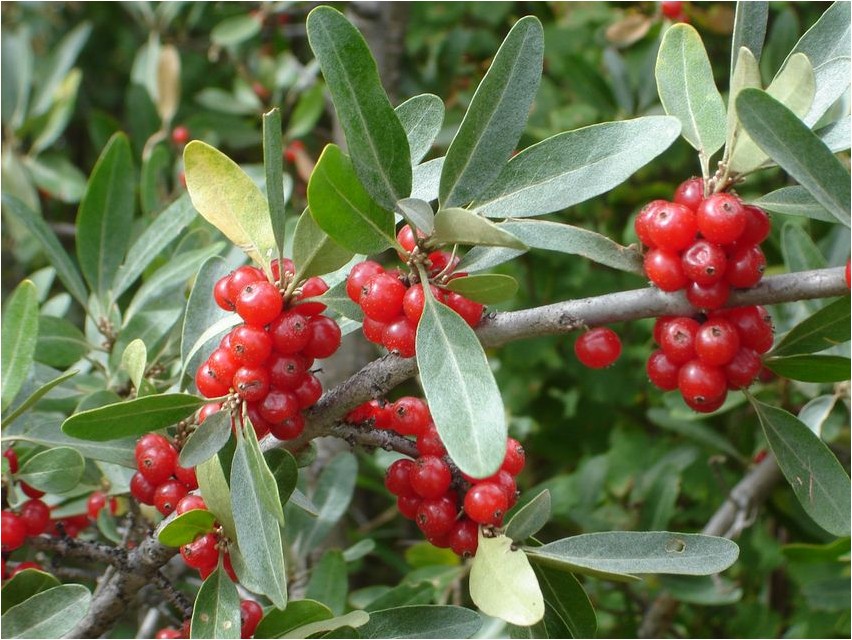
Shepherdia (lat. Shepherdia) is a genus of shrubs and small trees of the Sucker family. The genus includes three species: Shepherdia argentea, Shepherdia canadensis and Shepherdia rotundifolia.
Natural range — North America. Culture appeared relatively recently in Russia. The plant is famous for its bright red edible berries with subtle white dots.
Characteristics of culture
Shepherdia is a shrub, or less often a tree, up to 6-7 m high. The root system is powerful and well developed. The crown is wide, up to 13-15 m in diameter. The branches are outstretched, often creeping, equipped with thorns. The shrub can be single-trunked or multi-trunked. The leaves are elongated-lanceolate, opposite, as well as the shoots, pubescent with silvery hairs over the entire surface.
The flowers are inconspicuous, yellowish, collected in spike-shaped inflorescences. The fruit is a drupe and has a sour-sweet taste, often with bitterness. Shepherdia blooms in April-May before the leaves bloom. Flowering duration is on average 6-10 days. The plant is pollinated by insects. Shepherdia is a plant that is undemanding to growing conditions, winter-hardy, drought-resistant and light-loving.
Growing conditions
Shepherdia prefers well-lit areas, otherwise there are no restrictions. The soil can be any, since nodules with bacteria are formed on the roots of shepherdia, which actively absorb nitrogen from the air. That is why plants are able to grow on poor and even rocky soils, on which other fruit and berry crops will not survive. Loamy and sandy loam, drained soils with a neutral pH reaction are optimal. It is undesirable to grow the crop on heavy clay and salty soils; they greatly inhibit the plants. You should also avoid lowlands with stagnant cold air, as well as areas close to groundwater.
Reproduction and planting
Shepherdia is propagated by seeds, cuttings and root suckers. The seed method is effective, but complicated, since the seeds need preliminary stratification, which lasts about 60 days. You can sow seeds before winter, then they undergo natural stratification, which simplifies the work of gardeners several times. Shoots from autumn sowing, as a rule, appear in early May, sometimes earlier. Shepherdias grown in this way begin to bear fruit in the 4th-5th year, and by the 12th year the plants produce maximum yields.

The most common method of propagation among gardeners is by cuttings. Cuttings 8-10 cm long are taken from strong, healthy shoots of the current year in late June or early July. The cuttings are taken separately from female and male plants, with 10 times more female cuttings. One male plant is planted for every 7-10 female plants. Before planting, the cuttings are treated with growth stimulants, such as heteroauxin. The cuttings are planted at an angle in open ground under plastic or in a greenhouse, with a thin layer of washed coarse sand added on top. For several days, the cuttings are misted with warm water 3-5 times a day, and shaded during hot, sunny weather. After approximately 2-3 weeks, the cuttings begin to form roots.
Planting from seedlings is done in the spring, although fall planting is also possible. Planting holes are prepared in the fall, or a couple of weeks in advance. The hole should be approximately 70 cm deep and 80-90 cm wide. Fill the bottom of the hole with fertile soil, thoroughly mixed with mineral and organic fertilizers. The seedling roots are spread out, then the remaining voids are filled with soil, compacted, watered, and mulched with healthy fallen leaves or peat.
Care
For the first 2-3 years after planting, care consists of shallow tillage, weed removal, and watering. Subsequently, care consists of annual sanitary and formative pruning, pest and disease control, and fertilizing. Mature plants do not require watering, except during prolonged periods of no rain. Fertilizing is done twice a season: in early spring and midsummer.