Foxglove
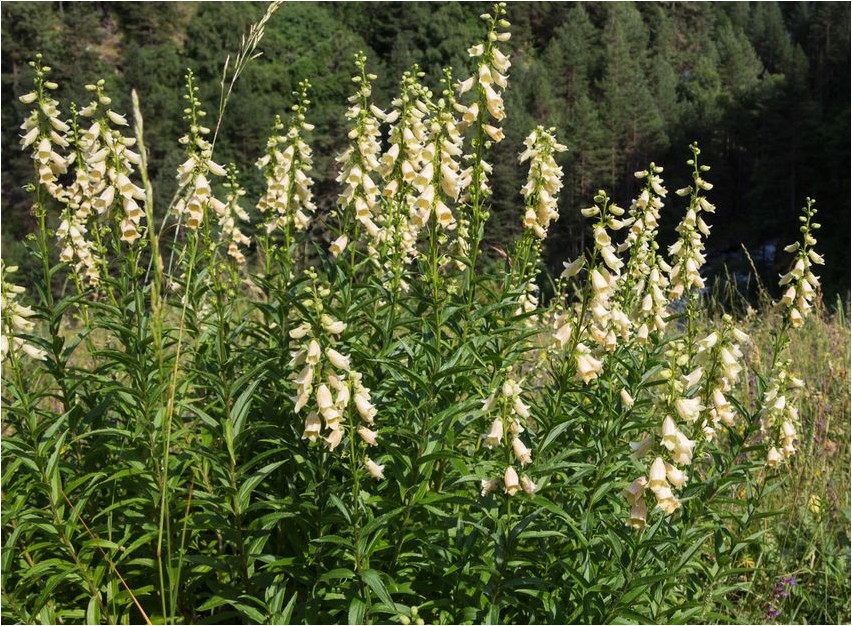
Foxglove is a member of the Scrophulariaceae family. Its Latin name is Digitalis ciliata Trautv.
The family name itself, Scrophulariaceae Juss.
Description of Foxglove
Foxglove is a perennial herbaceous plant with a multi-headed rhizome and simple, shortly pubescent stems. These stems grow to a height of approximately 30 to 60 centimeters. Its leaves are serrated, sessile, and linear-lanceolate. They are 4 to 7 centimeters long and 0. 5 to 1. 5 centimeters wide. These leaves are sharply serrated, pointed, tapering into a petiole, and the upper leaves are sessile. The flowers of the foxglove are bell-shaped, gathered in a one-sided flowering raceme with a thin, sinuous axis, and are colored either yellow or pale yellow. The fruit of this plant is an ovoid capsule, slightly larger than the calyx, and approximately five to seven centimeters long. The seeds of the foxglove are light yellow, tetrahedral-prismatic in shape, and one to two centimeters long.
This plant blooms from July to September. In the wild, this plant is found in the North Caucasus, Abkhazia, Samegrelo, and Svaneti. It’s worth noting that foxglove is not only a honey plant but also an ornamental plant, which is also poisonous to all types of animals.
Description of the medicinal properties of foxglove
Foxglove has very valuable medicinal properties, and the leafy shoots of this plant should be harvested between June and July. Dried foxglove leaves are recommended for use as a medicinal raw material for the production of various preparations.
The presence of such valuable healing properties should be explained by the content of flavonoids, cardiac glycosides and steroid glycosides in this plant. Based on the aerial part of the foxglove ciliate, the drug digicil is made, which is a novogalenic drug. Actually, in terms of its pharmacological properties, as well as contraindications and indications for use, this drug will be very close to all other drugs created on the basis of digitalis ciliata.

As for traditional medicine, here this plant is quite widespread. Here, foxglove leaves are used as a very effective cardiac remedy. The experiment proved that a drug based on the seeds of this plant will exhibit antiviral activity against the A2 virus, and can also be successfully used to treat influenza. The preparation from the seeds of this plant is based on a mixture of hydrocarbons, free fatty acids, triglycerides, stearins and lysoglycerides. In addition, the seeds of foxglove ciliata will also be endowed with antiamoebic activity.
Preparations created on the basis of all types of this plant will be endowed with a fairly high degree of cumulation. However, with long-term use of drugs based on digitalis ciliata, quite serious consequences can occur, for this reason constant consultations with your doctor are necessary.





