Fragrant bedstraw
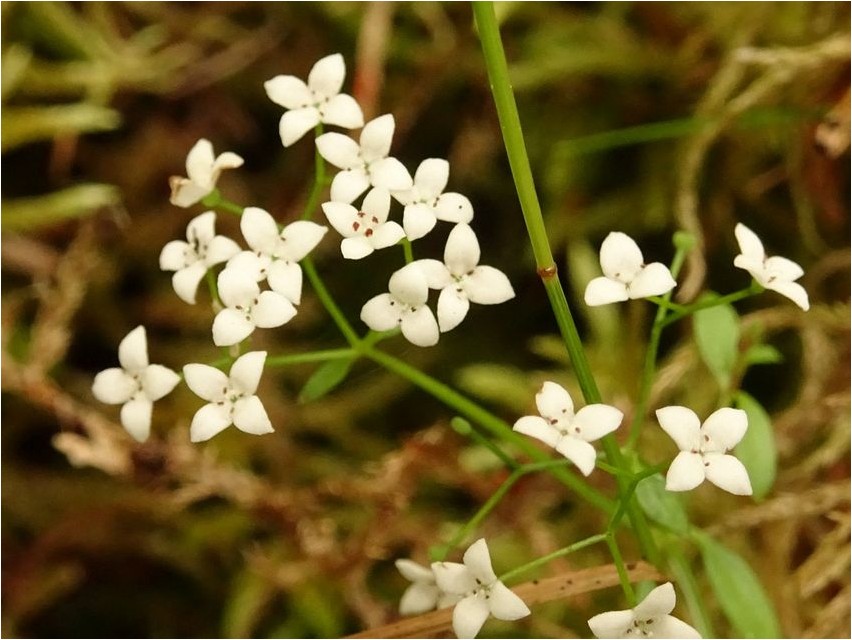
The fragrant bedstraw is one of the plants of the family called rotational plants; in Latin the name of this plant will be as follows: Galium odoratum (L.) Scop. (Asperuga odorata L.).
As for the name of the fragrant bedstraw family itself, in Latin it will be: Menyanthaceae Dumort.
Description of fragrant bedstraw
Fragrant bedstraw is a perennial herbaceous plant whose height will vary between ten and sixty centimeters. The stem of this plant is smooth and tetrahedral. The leaves of the fragrant bedstraw are found in whorls of six to ten pieces, they are oblanceolate, the length of such leaves is about four to five centimeters, and the width will be equal to one to three centimeters. Such leaves will be pointed and have a tapered base, and may sometimes be sparsely bristly. The inflorescence of the fragrant bedstraw will consist of several semi-umbrellas; it is apical, and at its base there will be about four to six bract leaves. The flowers of this plant are located on rather short stalks, they are fragrant and painted white, and the diameter of such flowers is about two to seven centimeters. The corolla of the fragrant bedstraw will be endowed with four blunt lobes, while the anthers will be exposed from the flower, and the style will be hidden in the corolla tube. The mericarps of this plant are spherical, their length is three to four centimeters and they will be covered with hook-shaped hairs.
Fragrant bedstraw blooms in the spring and at the beginning of the summer. Under natural conditions, this plant is found in the Caucasus, Central Asia, Sakhalin, the Kuril Islands and Primorye in the Far East, Crimea, Ukraine, Belarus, the Altai region of Western Siberia, the Angara-Sayan region of Eastern Siberia, as well as in all regions of the European part of Russia, with the exception of only the Dvina-Pechora and Karelo-Murmansk regions.
For growth, fragrant bedstraw prefers the banks of forest streams, springs, coniferous-deciduous and coniferous forests, moist and shady broad-leaved forests, soil rich in humus, ranging from lowlands to the mid-mountain zone.
Description of the medicinal properties of fragrant bedstraw
Fragrant bedstraw is endowed with very valuable healing properties, and it is recommended to use the fruits, rhizomes and grass of this plant for medicinal purposes. The term grass includes flowers, stems and leaves.

The presence of such valuable healing properties should be explained by the content of coumarins, tannins and higher aliphatic hydrocarbons in the composition of this plant, while anthraquinones and coumarins will be present in the rhizomes. The stems of this plant contain coumarins, and the leaves contain vitamin C, coumarins, carotenoids and asperuloside, while the flowers will contain iridoids.
For spasmophilia in children, it is recommended to use fresh bedstraw grass in the form of applications. A decoction prepared from the rhizomes of the fragrant bedstraw is recommended for use in cases of enterocolitis, acute gastritis, diseases of the liver and biliary tract, as well as as an astringent and analgesic for diarrhea and as a remedy that will have the ability to enhance potency.
It should be noted that the rhizomes and leaves of the bedstraw will exhibit antibacterial activity. In addition, the herb infusion is used as a very valuable sedative for depression, neuroses, hysteria and neurasthenia, and this remedy is used locally for allergic rashes.





