Clintonia uda
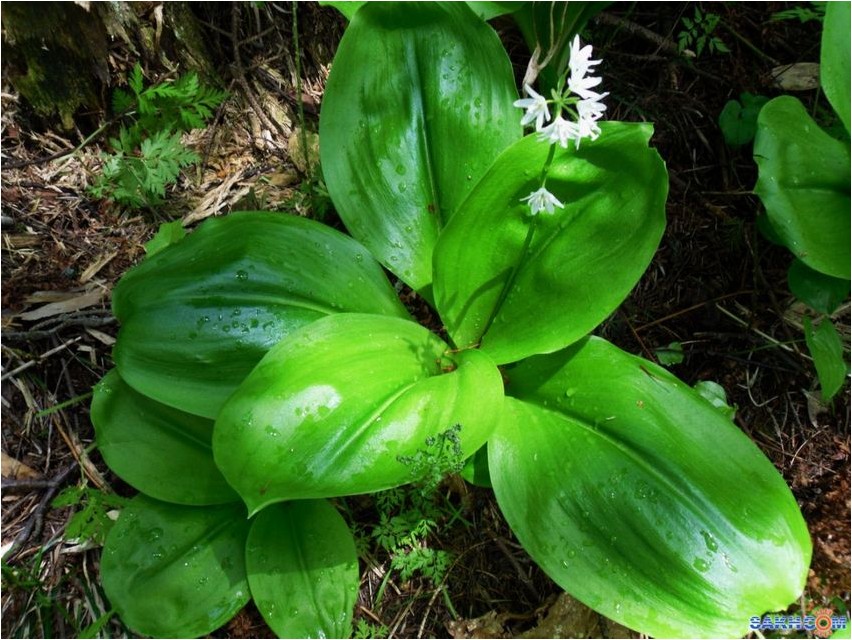
Clintonia udensis is one of the plants of the family called Liliaceae; in Latin the name of this plant will be as follows: Clintonia udens Traut. ex Mey.
As for the Latin name of the Clintonia uda family itself, in Latin it will be like this: Liliaceae Juss.
Description of Clintonia uda
Clintonia uda is a perennial herbaceous plant endowed with thick root lobes. Outside, the plant will be covered with vaginal, transparent and membranous scales, which will also surround the bases of the basal leaves themselves. It should be noted that the plant will vary greatly in appearance during the fruiting and flowering periods. It should be noted that during the flowering period the stem of this plant is quite short, and its height is about seventeen to twenty centimeters. Such a stem will be bare at the bottom, and at the top it will be felt-fluffy. There are about three to seven leaves at the base of the stem, they will be very close together and spread out, as well as obovate. At the base, such leaves will be petiolate-tapered, while at the top, such leaves are mostly endowed with a small pointed point. On top, the leaves of Clintonia udskaya are painted in green tones, below they will be paler, on both sides the leaves of this plant are bare, and along the edges they will be slightly ciliated. The umbrella-shaped flower raceme is endowed with approximately two to twelve flowers, which are located on felt-fluffy pedicels. The perianth of Clintonia uda is yellowish-white. During the flowering period, the leaves of Clintonia uda become larger, and the stem also becomes longer. At the very beginning of the ripening period, the fruits of this plant seem like berries, their length is one centimeter, and they are colored in dark blue tones. Subsequently, such fruits will dry out and turn into a cracking box, endowed with three incomplete nests.
The flowering period of the clintonia oudensis occurs from May to June. In the wild, this plant is found in the Far East, and in its general distribution, it is found on the Korean Peninsula, in northeastern China, and in Japan. It prefers virgin forests, most often coniferous forests with moss cover, and less commonly, mixed forests. It should be noted that the plant sometimes grows in mountainous regions. It is worth noting that the clintonia oudensis is poisonous, so caution should be exercised when handling it.
Description of the medicinal properties of clintonia oudensis
Clintonia oudensis has very valuable medicinal properties, and its root is recommended for medicinal purposes. It is recommended to harvest this raw material in both summer and autumn. To do this, dig up the plant and then thoroughly rinse the root in water, removing all small roots. The stem of the clintonia oudensis is trimmed, then cut into small pieces, and then left to dry.
In Chinese medicine, a decoction made from the roots of this plant is widely used. An alcohol tincture made from the roots of the clintonia oudensis is also equally effective. These highly valuable remedies should be used for bruises and abrasions, as well as general physical fatigue and cuts. However, it should be noted that an overdose of this remedy may cause diarrhea: this circumstance should be attributed to the fact that clintonia oudensis is a poisonous plant.





