Shepherd’s Purse
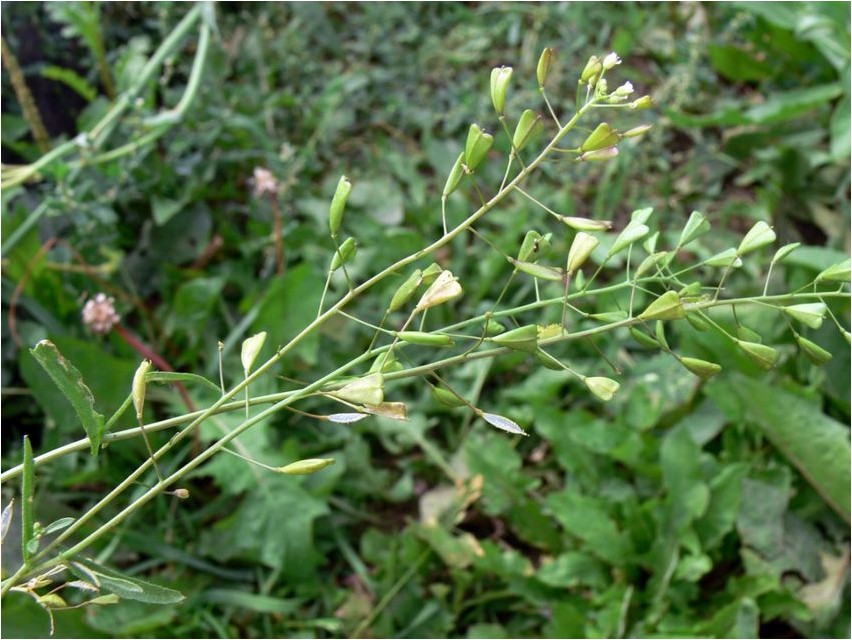
Shepherd’s purse is a member of the Brassicaceae or Cruciferae family. Its Latin name is Capsella bursa-pastoris (L.) Med.
The Latin name of the shepherd’s purse family is Brassicaceae Burnett (Cruciferae Juss.).
Description of Shepherd’s Purse
Shepherd’s purse is also known by the following common names: sparrow’s purse, vaoek, beeva kasha, leva’s buckwheat, girchak, wild flax, purse, cuddle flax, bedbug flax, swan flax, bear’s purse, bagwort, siskin’s eye, and Yakutka. Shepherd’s purse is an annual herbaceous plant, reaching a height of between twenty and forty centimeters. This plant has a thin, spindle-shaped root. The stem is erect, solitary, and can be either branched or simple. The lower portion of the stem is pubescent with simple or branched hairs. The lower leaves of shepherd’s purse form a rosette; they are most often pinnately divided and oblong-lanceolate, with lobes or triangular teeth. The cauline leaves of this plant are alternate, oblong-lanceolate, sessile, and auricular, and can be either sinuate-dentate or entire. The upper leaves of shepherd’s purse are nearly linear and clasping the stem, with a sagittate base. The flowers of this plant are small, white, and borne on erect peduncles, forming racemes that initially appear umbel-shaped. The fruit of shepherd’s purse is a pod containing small, flattened, elliptical seeds of light brown color. These seeds are approximately one millimeter long, while the fruit itself is approximately five to eight millimeters long. Shepherd’s purse fruits are quite numerous, and they ripen starting from the bottom of the inflorescence.
In the wild, this plant is found in Russia, Belarus, and Ukraine. It is worth noting that shepherd’s purse is a common weed that is common in vegetable gardens, fields, and orchards, and also grows in trash heaps along canals, roads, embankments, and near houses.
Description of the medicinal properties of the shepherd’s purse
The common shepherd’s purse is endowed with very valuable healing properties, and it is recommended to use the roots, stems, flowers and leaves of this plant for medicinal purposes.
This plant is indicated for use in various types of bleeding, and also has the ability to lower blood pressure, stop diarrhea, increase urine output, and will also cause uterine contractions and constrict peripheral blood vessels. Also, shepherd’s purse has found quite wide distribution in homeopathy, where this plant is used for various kidney diseases and all types of bleeding.

As for traditional medicine, shepherd’s purse is also used quite widely. An infusion and liquid extract based on this plant is used in gynecological practice for uterine atony, and is also used as a sedative, hemostatic and wound healing agent. In addition, such healing agents are indicated for use in a number of neuropsychiatric diseases. Infusion and fresh juice of this plant are used for tumors, stomach cancer, pulmonary hemorrhages and malignant ulcers.





