Oak
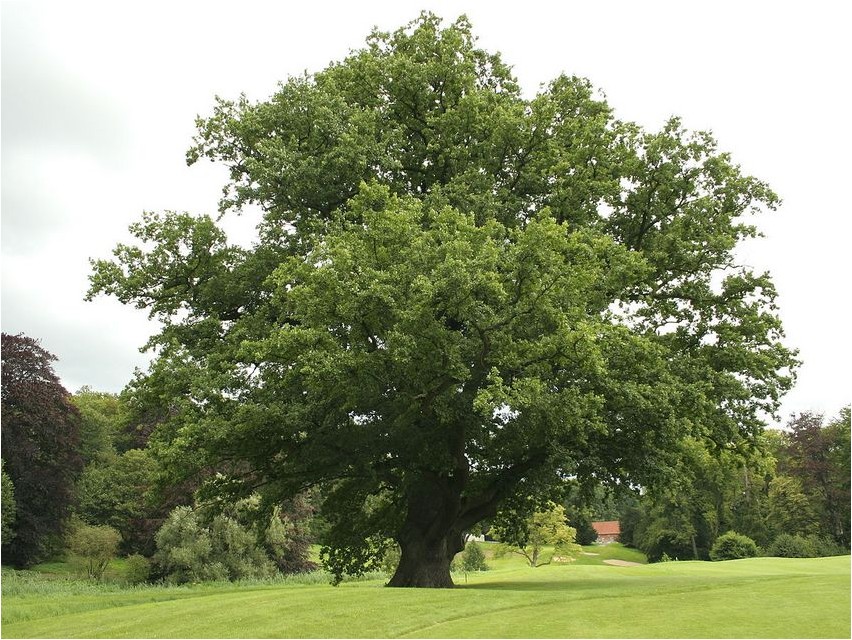
Oak (lat. Quercus) is an ornamental plant; genus of trees and shrubs of the Beech family. Currently, more than 600 species are known. Under natural conditions, oak grows in regions of the Northern Hemisphere with a temperate climate.
Some species are also found in tropical highlands, such as the Greater Sunda Islands and Bolivia.
Characteristics of culture
Oak is a tall, powerful deciduous, less often evergreen tree or shrub with a lush crown. The leaves are leathery, lobed or whole, and are particularly decorative. In evergreen species, leaves remain for several years, while in others they fall annually.
The flowers are small, simple, poorly developed; both female and male flowers are formed on the same plant. Female flowers are presented in the form of long hanging earrings or small bunches, male flowers — also in the form of standing or long earrings. At the base of the female flowers, scale-like leaves are formed, located on an annular ridge, which is a kind of receptacle. The ovary of the flowers is three-lobed, but during the ripening of the fruits it grows together into one nest.
The fruit, an acorn, is a dry single-seeded fruit with a hard pericarp enclosed in a kind of cup — a plus. A plus is formed when the fruit ripens. In different types of oak, the shape of the scales and the size of the acorns are varied; there are varieties with acorns with turned-off scales.

Oak is a source of valuable wood; surprisingly, plants live quite a long time — 300-400 years. By the way, specimens up to 1. 5-2 thousand years old are known. Oak trees grow in height in the first 100 years, but growth in thickness does not stop throughout life.
Application
Most oak species are highly ornamental plants. Oak trees are used in single and group plantings, to decorate alleys, as well as green areas in combination with deciduous trees, including ash, chestnut, maple and sycamore. Small-leaved holm oaks are used to create hedges in formal gardens. Red oak in group plantings protects against noise and strong winds.
Growing conditions
Oak is a light-loving plant, frost-resistant and drought-resistant. The crop is not demanding in terms of soil composition and is able to grow and develop well even on acidic, saline and dry soils. It has a negative attitude towards waterlogging, although it tolerates short flooding calmly. Areas for growing oaks are preferably well-lit; some species are able to grow in areas with lateral or complete shade.
Reproduction and planting
The crop is propagated by acorns. Sowing is carried out in the fall immediately after collecting planting material. Important: acorns are poorly stored in artificial conditions and may not sprout when planted the next year. Young trees grown from acorns are planted in the spring. Oak trees are often propagated by coppice shoots; this method is effective provided that the tree from which the planting material is taken is at least 20 years old. Ornamental varieties of the crop are also propagated by grafting; oak species that are resistant to unfavorable growing conditions are used as rootstocks.
Oak seedlings are planted in sunny areas. The pits are prepared in advance, a third of the pit is filled with a substrate consisting of turf soil, peat and sand, and a drainage layer is also added to the bottom, which can be crushed stone or pebbles. The root collar of the seedling should be slightly above ground level. Immediately after planting, young plants are watered abundantly, and watering is also necessary for the next four days.
Care
Despite the fact that oaks are drought-resistant plants, they require regular watering, especially in the absence of natural precipitation for a long time. Young plants are more sensitive to drought. In winter, the tree trunks of oak trees are mulched with peat or wood chips to insulate the root system. The mulch layer should be about 10-15 cm.
In spring, plants need fertilizing with urea, mullein and ammonium nitrate. They also periodically trim frozen, dry and broken branches, and clean the trunks of spiny shoots.
Since oak trees are susceptible to various diseases caused by fungi and bacteria, it is necessary to carry out preventive treatments in a timely manner. Powdery mildew is considered one of the most dangerous diseases for oak trees; when the first signs are detected, the plants are sprayed with a 1% solution of copper sulfate. Oak trees are also susceptible to attack by pests, such as gall midges. These insects lay eggs inside the leaf, and the grown larvae form dense spherical yellowish growths on its surface. To avoid the appearance of gall midges, it is necessary to regularly remove and burn fallen leaves.
Oak
https://www. youtube. com/watch? v=gQRAtK04kjU