Campanula patula is a member of the Campanulaceae family. Its Latin name is Campanula patula L.
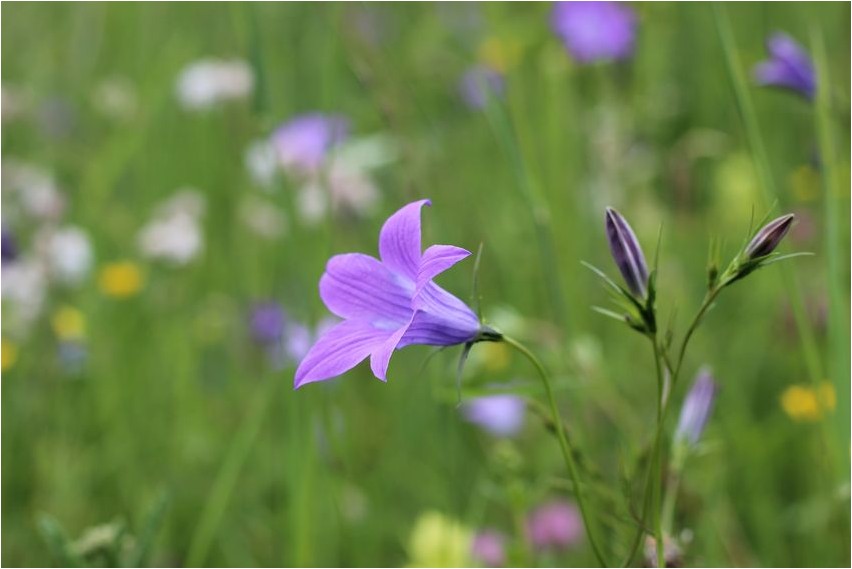
The family name of Campanula patula is Campanulaceae Juss.
Description of Campanula patula
Campanula patula is a biennial herbaceous plant, reaching a height of between ten and seventy centimeters. Its stem is branched and slender. The lower leaves of Campanula patula can be either palmate or oblong-obovate, while the middle and upper leaves are linear-lanceolate or lanceolate. The flowers of this plant are quite large, reaching up to three centimeters in length. These flowers are borne on fairly long peduncles, which form a loose, paniculate inflorescence. The calyx teeth of Campanula diffusa are mostly strongly deflected and spreading. The corolla is most often blue-violet in color, and is sometimes white, also featuring dark veins. The lobes of this corolla are large and slightly recurved. The fruits of Campanula diffusa are capsules that sit on straight stalks and open with holes at the apex.
Campanula diffusa blooms from early summer until autumn. In the wild, this plant is found in European Russia, Ukraine, and Western Siberia. It prefers forests, clearings, forest edges, meadows, and fallow lands.
Description of the medicinal properties of Campanula diffusa
Campanula diffusa has very valuable medicinal properties, and the roots and herb of this plant are recommended for medicinal purposes. The term “herb” refers to the flowers, leaves, and stems of Campanula diffusa.
The presence of such valuable medicinal properties can be attributed to the presence of steroids, triterpenoids, saponins, cardenolides, alkaloids, anthocyanins, phenolic acids and their derivatives, as well as the following nitrogen-containing compounds: choline, stachydrine, and betaine. Alkaloids are found in the stems, leaves, and flowers of Campanula diffusa.
A decoction prepared from the roots of this plant is recommended for use in hydrophilia. As for traditional medicine, a decoction based on the spreading bellflower herb has become quite widespread. Such herbal decoction should be used for headaches, laryngitis, epilepsy and numerous female diseases. A decoction of the roots and alcohol extract of the herb of this plant is endowed with very valuable anticonvulsant properties.

For migraines and anxiety, it is recommended to use the following remedy based on Campanula: to prepare this remedy, you will need to take one teaspoon of Campanula roots per glass of boiling water. The resulting mixture should be boiled over fairly low heat for four to five minutes, then this mixture is left to infuse for one hour and boiled water is added up to the original amount of decoction, after which this healing mixture is filtered very carefully. Take the resulting remedy based on the spreading bell three to four times a day, one-third of a glass. It is noteworthy that to achieve the greatest effectiveness when taking such a remedy. You should strictly follow all the rules for the preparation and administration of this remedy based on the spreading bellflower.
Spreading bell





