Altai Honeysuckle
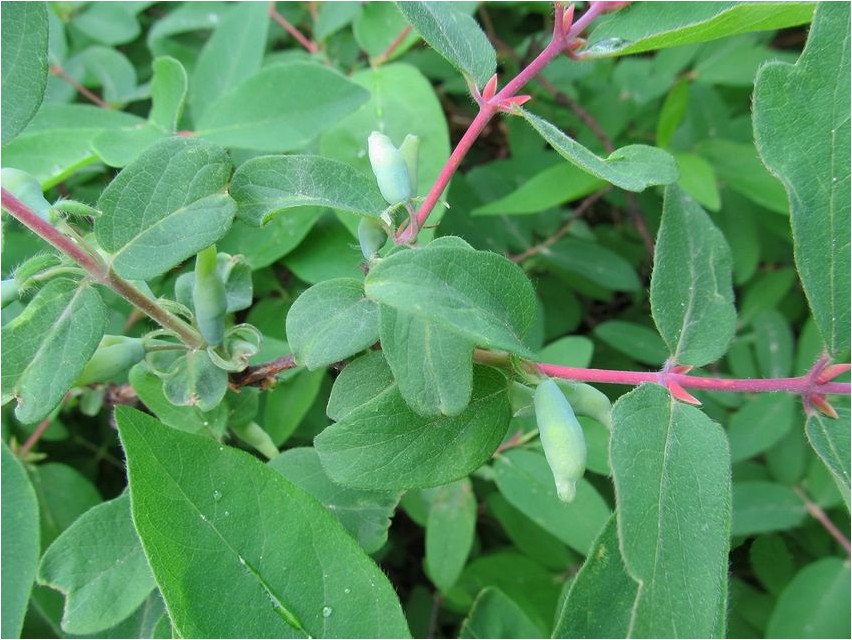
Altai honeysuckle is a member of the Caprifoliaceae family. Its Latin name is Lonicera altaica Pall. ex DC.
The Latin name of the Altai honeysuckle family is Caprifoliaceae Juss.
Description of Altai Honeysuckle
Altai honeysuckle is a low shrub, reaching heights between one and one and a half meters. The plant has brownish-gray bark. Young shoots are colored in reddish tones. The leaves of Altai honeysuckle are short-petioled, entire, and oval-elliptical in shape. The flowers are pale yellow. The fruits of the Altai honeysuckle grow at the ends of the fruiting branches and can be either ovoid or oval in shape. These fruits are often double, and can be either blackish-blue or bluish with a waxy coating.
Altai honeysuckle blooms in June, while the fruits ripen from July to August. In the wild, the plant is found in the southern Okhotsk region of the Far East, as well as in the following regions of Western and Eastern Siberia: Salair, Mountain Shoria, and Kuznetsk Ala-Tau. It prefers forest edges, forest clearings, forest-steppes, and coniferous and mixed forests. Description of the medicinal properties of Altai honeysuckle
Altai honeysuckle possesses valuable medicinal properties, and its fruits, leaves, flowers, and branches are recommended for medicinal purposes.
These valuable medicinal properties are explained by the leaves and branches’ content of organic acids, tannins, vitamin C, the flavonoid 7-glucoside luteolin, and atocyanidins (cyanidin and chrysanthemin). The fruits of this plant also contain tannins, catechins, organic acids, terpenoids, and vitamin P.
The plant has valuable diuretic, astringent, anti-inflammatory, hypotensive, and antispasmodic properties. A decoction of the bark and branches of Altai honeysuckle is recommended for dropsy and edema, and fresh berries should be taken for gastric and duodenal ulcers, diarrhea, colitis, hypertension, anemia, malaria, and atherosclerosis. Fresh berries of this plant can also be used as a restorative and a general tonic.

In homeopathy, an essence is prepared from the fruits. A decoction of the fruits is also used externally to rinse the throat, mouth, and eyes. The fruits of this plant are used as a valuable remedy for improving memory. Externally, the juice is used for stomatitis and gingivitis. A natural dye has been isolated from the fruits, which, in experiments, has been shown to have capillary-strengthening properties. It is noteworthy that triterpene acids possess valuable hormonal properties.
In folk medicine, a decoction of the bark is used for headaches and polyarthritis. The leaves have both protisticidal and antibacterial properties. For metabolic disorders, an infusion of Altai honeysuckle leaves should be used. For laryngitis, dermatoses, eye diseases, and numerous gynecological ailments, a decoction made from the leaves and flowers of Altai honeysuckle is recommended.
The fruits of this plant are used to make jelly, juice, and jam. The fruits can also be eaten fresh or dried.
ALTAIAN HONEYSUCKLE || Beneficial Properties and Uses





