Broadleaf Echinops
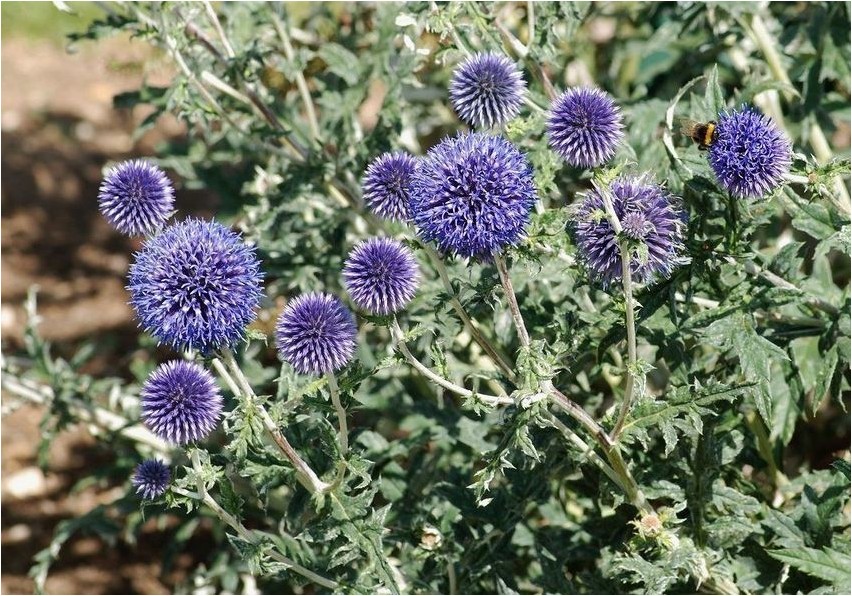
Broadleaf Echinops is a member of the Asteraceae or Compositae family. Its Latin name is Echinops latifolius Tausch.
The Latin name for the broadleaf Echinops family is Asteraceae Dumort. (Compositae Giseke).
Description of Broadleaf Echinops
Broadleaf Echinops is a perennial herbaceous plant, reaching heights between thirty and seventy-five centimeters. Its stem is simple or weakly branched, with a slightly cobwebby pubescence at the base and a nearly tomentose texture at the top. The leaves of Broadleaf Echinops are bipartite or tripartite, and may also be incised. The leaves are slightly cobwebby on top, though rarely they can be almost smooth. Beneath, they are almost tomentose, with edges that can be either spiny-lobed or spiny-toothed. The basal leaves of the broadleaf echinops are on fairly thick petioles, approximately ten to fifteen centimeters long, and are pinnately divided. The lower stem leaves of this plant clasp the base of the stem and are also pinnately incised. The upper stem leaves of this plant are ovate and pinnately incised, sometimes with finely dissected lobes. The flower heads of this plant are approximately four to six centimeters in diameter, with bluish tones. The flower heads of the broadleaf echinops reach two centimeters in length. These flower heads are nearly ovoid, widest in the middle, and densely surrounded by rough, slightly longer involucral stamens. The involucral leaflets of this plant are glabrous, while the outer leaflets are spatulate and pointed.
Blooming of the broadleaf Echinops occurs in May, while fruiting occurs in June. In the wild, this plant is found in Eastern Siberia, Mongolia, and China. It prefers steppe and rocky slopes, mountain and flat steppes, fallow lands, and sandy and rocky soils.
Description of the medicinal properties of the broadleaf Echinops.
Echinops latifolia is endowed with very valuable healing properties, and for medicinal purposes it is recommended to use the rhizome and roots of Echinops latifolia. The presence of such valuable healing properties should be explained by the content of coumarins, essential oil, flavonoid hyperin and alkaloid echinopsin in this plant.
As for Chinese medicine, this plant is quite widespread here. Chinese medicine uses this plant as a hemostatic agent and is used externally for various skin diseases. A decoction prepared from nine to fifteen grams of Echinops latifolia roots is recommended for use for mastitis, rheumatic pain in the joints, rheumatism, mumps, tuberculosis of the lymph nodes, purulent tumors and lack of milk in nursing mothers.

Mongolian medicine uses a decoction based on the roots and rhizomes of Echinops latifolia as a tonic and choleretic agent, and is also used for Botkin’s disease, various liver diseases, liver echinococcosis, neuropsychiatric disorders, bile ducts and esophageal cancer. Tibetan medicine recommends using a decoction of the rhizomes of Echinops latifolia for diseases of the throat, stomach, lungs, blood and osteomyelitis, and this remedy is also used as a valuable wound healing agent.





