Single-columnar dodder
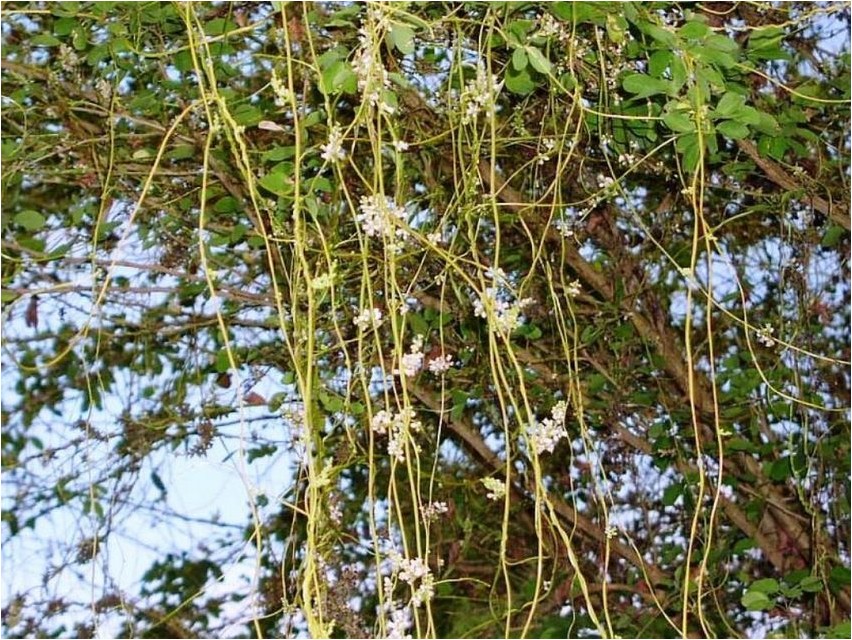
Single-columnar dodder is one of the plants of the family called dodder; in Latin, the name of this plant will be as follows: Cuscuta monogina Vahl.
As for the name of the dodder family itself, in Latin it will be: Cuscutaceae Dumort.
Description of single-columnar dodder
Single-columnar dodder is an annual herbaceous plant. The stems of this plant are cord-like, their thickness reaches two millimeters, they are branched, and will be colored either light or reddish. The length of dodder flowers will be about three and a half to four and a half millimeters, they can be sessile or can be on noticeable pedicels. In color, such flowers will be almost white or pinkish; they are collected in loose, few and spike-shaped inflorescences. The length of the corolla of single-columnar dodder will be about three to three and a half millimeters, the corolla is pitcher-shaped, the petals will be ovoid and are almost half as long as the tube of the corolla itself. The capsule of this plant can be almost spherical or ovoid, the length is about four millimeters. The capsule is also smooth and has one or two seeds. The length of dodder seeds is four millimeters; they can be colored in both light brown and dark brown tones.
Single-columnar dodder blooms from June to July, while the fruits will ripen from July to August. Under natural conditions, this plant is found in the European part of Russia, Central Asia, the Caucasus, in the Dnieper region in Ukraine, as well as in Western and Eastern Siberia. For growth, this plant prefers gardens, vineyards, river valleys, floodplain meadows, and will also parasitize berry, ornamental, field and fruit crops.
Description of the medicinal properties of single-columnar dodder
Single-columnar dodder is endowed with very valuable healing properties, and it is recommended to use the herb of this plant for medicinal purposes. The term grass includes leaves, flowers and stems.
The presence of such valuable healing properties is recommended to be explained by the content of the following phenolcarboxylic acids and their derivatives in this plant: caffeic, chlorogenic and p-coumaric, and flavnoids, coumarins and tannins will also be present. A decoction prepared from this plant is recommended for use against malaria, atony of the stomach and intestines. In addition, this remedy is used as a choleretic, antipyretic and diaphoretic. It is noteworthy that the experiment proved that dodder showed the ability to increase diuresis by twenty-five percent.

As a choleretic agent, it is recommended to use the following very effective plant based on this plant: to prepare such a healing remedy, you will need to take one tablespoon of dodder herb per glass of water. It is recommended to boil the resulting healing mixture for about three to four minutes, after which this mixture is left to infuse for about two hours, then such a healing remedy based on this plant should be filtered very carefully. Take the resulting medicinal product based on dodder one or two tablespoons three times a day as a very effective choleretic agent. If prepared correctly, such a healing remedy will be very effective.





