St. John’s wort
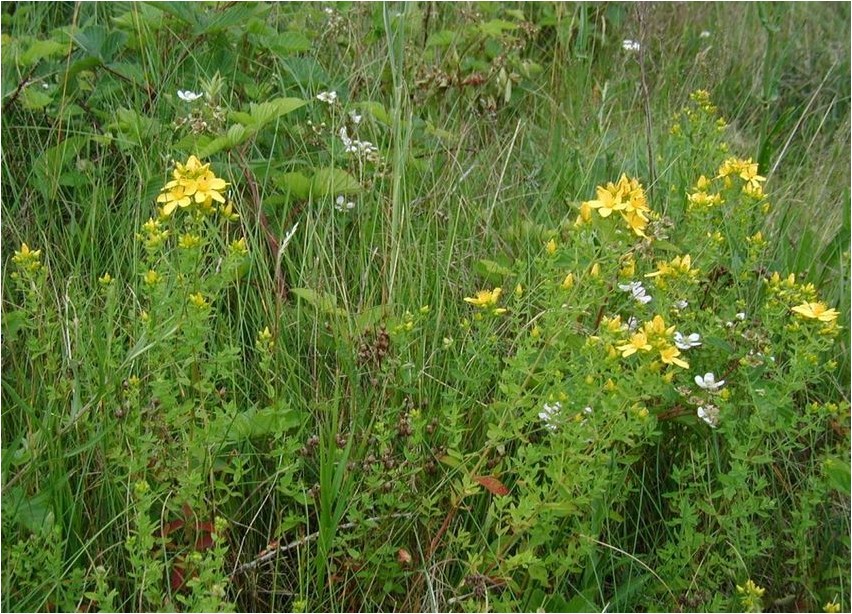
St. John’s wort is one of the plants of the family called St. John’s wort; in Latin the name of this plant will be as follows: Hypericum erectum Thunb.
As for the name of the St. John’s wort family itself, in Latin it will be: Hypericaceae Juss.
Description of St. John’s wort
St. John’s wort is a perennial herbaceous plant whose height will vary between twenty-five and seventy centimeters. The stems of this plant will be straight and ridged; they can be either completely simple or branched at the top. It is noteworthy that most of these stems will be purple. The leaves of this plant are opposite, lanceolate, sessile and almost stem-embracing. Such leaves are pointed and entire, they are endowed with rather rare pinpoint glands, which are located on the very surface; such glands are painted black.
The flowers of St. John’s wort will mostly be numerous; they are found in sparse paniculate or corymbose inflorescences. The petals of the flowers of this plant are painted in pale yellow tones; in shape they will be oblong-obovate or oblong. On the surface and along the edge, such petals will be endowed with black glandular dots and dashes. Numerous stamens are located in three bunches, and the anthers are endowed with black dotted glands. The ovary is ovoid in shape. The fruit of this plant is an ovoid or ovoid-oblong capsule, endowed with oblong grooves and yellow glandular stripes. The box itself will be painted in brown tones. The seeds of this plant are either oblong or cylindrical in shape, they are shiny and finely longitudinally cellular.
St. John’s wort blooms from July to August. Under natural conditions, this plant is found in the Far East: the Kuril Islands and Sakhalin. As for its general distribution, this plant is found on the Korean peninsula, Japan and Northeast China.
Description of the medicinal properties of St. John’s wort
St. John’s wort is endowed with very valuable healing properties, and it is recommended to use the herb of this plant for medicinal purposes. The term grass includes leaves, flowers and stems. The presence of such valuable healing properties is explained by the content of the anthraquinone hypericin in the plant.

A decoction of the herb and juice of this plant is used as a hemostatic agent and also as an antipyretic for headaches. An infusion of St. John’s wort is recommended for urolithiasis and nephritis. The herb is used in baths for neurasthenia, neuroses, and rheumatism. An extract made from the leaves and flowers of this plant is recommended for dermatomycosis.
A decoction of St. John’s wort is recommended for various menstrual irregularities, as well as for bloody vomiting, nosebleeds, and gastrointestinal hemorrhages. For external use, a decoction of any amount of the herb or a powder soaked in water is used as plasters or tampons for carbuncles, venomous snake bites, and external traumatic bleeding. An infusion of this plant is used as a hemostatic, antipyretic, and astringent: to prepare it, take ten grams of dry, crushed herb per glass of water. Boil this mixture for five minutes and let it steep for two hours. Take one-third of a glass daily.
St. John’s Wort Excellent Flare. Brief overview, description of hypericum inodorum Excellent Flare





