Chinese cabbage
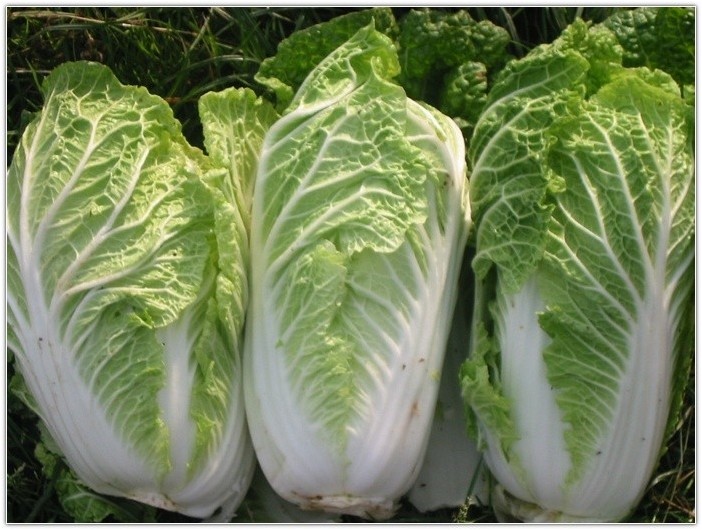
Chinese cabbage (lat. Brassica rapa subsp. pekinensis) is a vegetable crop; herbaceous plant of the Cruciferous or Brassica family.
Other names are Chinese cabbage, slaw or petsai. The homeland of the plant is China. Chinese cabbage is widely cultivated in Western Europe, Southeast Asia and the USA. On the territory of the Russian Federation, the crop is cultivated in small quantities.
Characteristics of culture
Chinese cabbage is a biennial plant, cultivated as an annual. The leaves are entire, succulent, yellow, yellow-green or bright green, sometimes slightly pubescent, with a flat or triangular white vein in the middle, with jagged or wavy edges, the inside is pimply. The leaves form a loose head or rosette. When cut, the heads of cabbage are yellow-green in color.
Chinese cabbage is a cold-resistant crop; adult plants can easily withstand frosts down t o-5C. The optimal growing temperature is 15-22C. Chinese cabbage is a long-day plant. When sown early, plants increase their vegetative mass, and when the day is long, they throw out flower stalks, bypassing the head phase. The growing season for cabbage is 48-55 days.
Growing conditions

Peking cabbage is a light-demanding plant that develops well in open, sunny areas. The culture is resistant to shading, although the heads or rosettes of leaves in this case are small and tasteless. The soils for growing Chinese cabbage are preferably fertile, moderately moist with a neutral pH. Waterlogged soils are not recommended.
Sowing
Peking cabbage seeds are sown in 2-3 terms. For continuous harvesting, the crop is sown at intervals of 10-15 days. The first sowing is done in early spring under film cover. It is not recommended to sow cabbage from July 15 to 20, since the plants prematurely send out flowering stems without forming either a large rosette or heads of cabbage. The last sowing is carried out in the first ten days of August. The seeding depth is 0. 5-1 cm. Most often, crops are sown using a strip method, the distance between rows should be 20-25 cm. With the emergence of seedlings, the crops are thinned out, leaving 10-20 cm between plants.
Growing Chinese cabbage by seedlings is not prohibited; in this case, sowing is carried out at the end of December in cassettes with cells. Seedlings are planted in the ground 25-30 days after emergence according to the following schemes: leaf varieties — 20*20 cm, half-headed varieties — 30*30 cm, cabbage varieties — 35*35 cm. Chinese cabbage is grown not only as the main crop, but also as a compactor. In winter, plants can also be grown on a windowsill.
Care
The main tasks for caring for Chinese cabbage are watering, weeding, loosening and pest and disease control. The culture responds positively to feeding with liquid mullein or urea.
Harvesting and storage
Leaf forms are cut so as not to damage the growing points, otherwise the plants will not produce a new harvest of leaves. Store them in plastic bags in the refrigerator for 12 days. The final harvesting of Chinese cabbage is carried out when the rosette or heads are fully developed.