Ragwort hemp-leaved
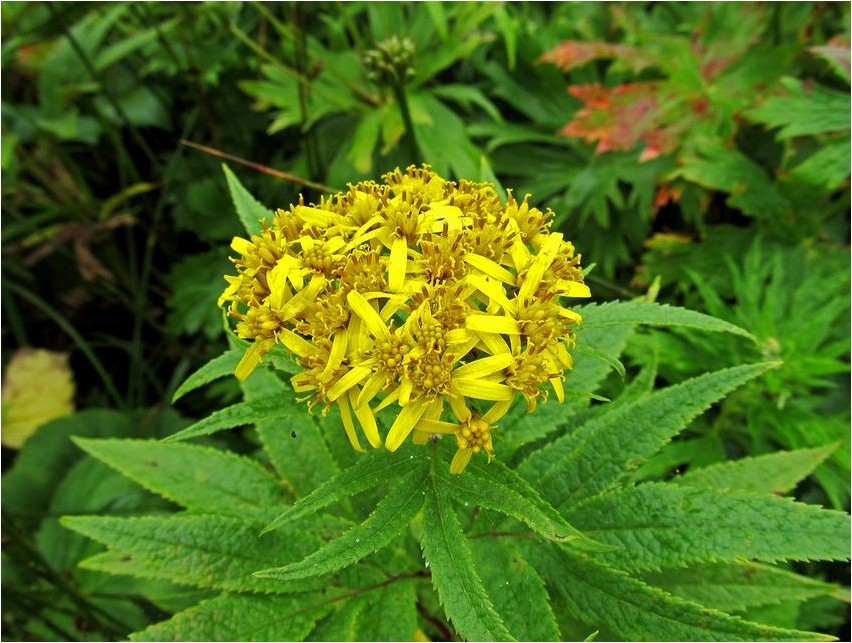
The hemp-leaved ragwort is one of the plants of the family called Asteraceae or Asteraceae; in Latin the name of this plant will be as follows: Senecio cannabifolius Less.
As for the name of the ragwort family itself, in Latin it will be like this: Asteraceae Dumort.
Description of ragwort hemp-leaved
Hemp-leaved ragwort is a perennial herbaceous plant whose height will fluctuate between one and two meters. The rhizome of this plant is shortened, it will be planted with numerous rather thin roots. The stem of the ragwort will be bare, simple and straight. The leaves are almost sessile and pinnately cut, their edges will be serrated, such leaves are glabrous, their length is eight to ten centimeters, and their width is about one to two centimeters. The leaves of this plant are dark green on top, and lighter below. The inflorescence of the ragwort cannabifolia is located at the very top of the stem, such an inflorescence will be paniculate-corymbose, while the baskets of this plant are on rather thin peduncles, which will be more or less long. The reed flowers are colored yellow, their length is five to ten millimeters, and their width is about two millimeters. The achenes are naked, and their length does not exceed four millimeters.
Flowering of the ragwort hemp-leaved plant occurs in July. Under natural conditions, this plant will be found in the Far East, the Eastern Arctic, as well as in the Daursky and Leno-Kolyma regions of Eastern Siberia. For growth, the plant prefers the edges of deciduous forests, places among bushes and coastal meadows.
Description of the medicinal properties of ragwort hemp-leaved
The hemp-leaved ragwort is endowed with very valuable healing properties, and it is recommended to use the herb of this plant for medicinal purposes. The concept of grass includes the leaves, stems and flowers of the ragwort hemp-leaved plant.
The presence of such valuable healing properties should be explained by the content of jacocin, the alkaloid otosenine, senecionine, cannabin, floradanine and seneciphylline in this plant.

The herb of this plant was widely known in Chinese medicine. Here, the grass of the ragwort hemp-leaved plant was used as a fairly effective external hemostatic and analgesic. Most often, this remedy was used for tumors, and in addition it was also used for pain during the prenatal period. It is recommended to eat the rhizomes of this plant raw in the spring. Dried and mashed leaves of this plant can be added to food.
For tumors and in the prenatal period, you should use the following remedy based on ragwort hemp: to prepare such a very effective remedy, you will need to take one tablespoon of crushed dry herb of this plant per glass of water. The resulting mixture based on this plant should be boiled for about three to four minutes, then this medicinal mixture is left to infuse for at least one hour, after which this medicinal mixture should be filtered very carefully. Take the resulting healing remedy based on ragwort hemp leaves three times a day, one to two tablespoons three times a day. It should be noted that in order to achieve the greatest effectiveness when taking a product based on ragwort hemp, it is recommended to strictly follow the standards for the preparation of such a product, and in addition, also comply with all the rules for its administration.