Larch
Larch (lat. Larix) is a genus of trees in the Pine family. Today, larch is one of the most common coniferous species.
In nature, the culture is found in almost all corners of the world; it occupies significant areas in the Far East, Siberia and the Urals. The genus has about 20 species. Larches are long-lived; specimens up to 800 years old have been recorded in natural conditions.
Characteristics of culture
Larch is a tree with a loose cone-shaped crown when young and a blunt-apex, ovoid or rounded crown when mature. There are larches with a one-sided flag-shaped crown, this is a consequence of constant piercing winds. The root system is powerful, highly branched, and does not have a pronounced tap root. In permafrost conditions, plants form a shallow root system; such trees often suffer from windfall.
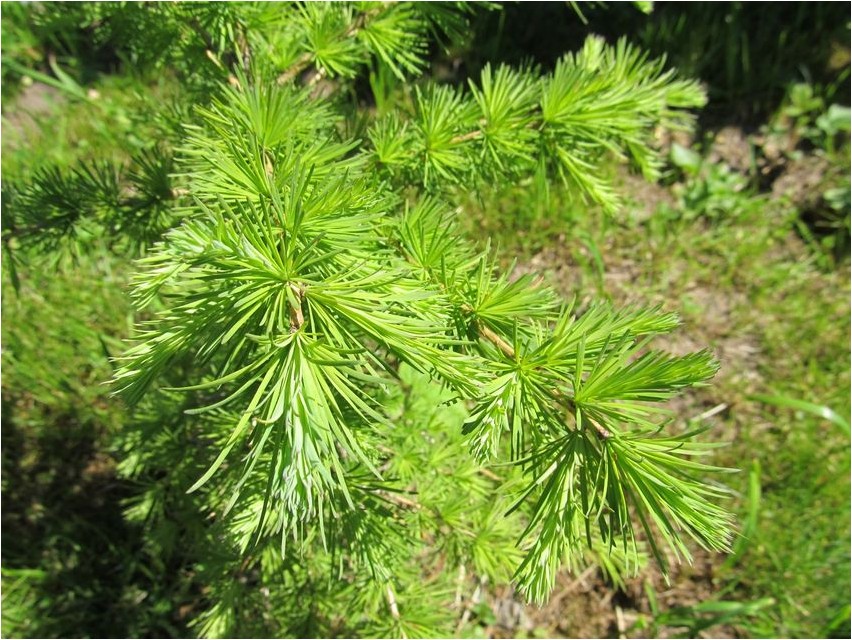
The needles are bright green, soft, narrow-linear, located in bunches on short shoots, singly or spirally on long shoots. With the onset of autumn, the needles acquire a golden-yellow color, and subsequently completely fall off. The cones are cylindrical, ovoid or round, and ripen in the year of flowering. The seeds are triangular, winged, located under each scale. Seeds, when properly stored, remain viable for up to 4 years. Seeds collected from lonely specimens are sterile. Larches are distinguished by gas and winter resistance, as well as cold-resistant properties; they can develop even in northern regions with harsh winters.
Growing conditions
Larch is one of the extremely light-loving crops; in heavily shaded areas it develops poorly and often dies. Under optimal conditions, trees grow quickly and by the age of thirty they add up to 100 cm of growth. As mentioned above, the culture is resistant to any temperature changes; in the far north it is not afraid of seventy-degree frosts.
Larch also does not make any special demands on soil conditions; it can grow without problems in both waterlogged and swampy soils, but in such areas the plants are usually stunted and stunted. Well-drained, moderately moist, sandy or loamy soils are optimal for larch.

Reproduction
Larches propagate by seeds and cuttings, but the latter method is ineffective. Grafting is also not prohibited, but is advisable only when propagating decorative and valuable forms. Seeds are sown immediately after collection in seedling containers with light, fertile soil. The seeds of the crop take a long time to germinate, so they are sown very densely. Before sowing, the seeds do not need to be processed, although stratification will speed up the germination process. Young plants are transplanted into shkolki (beds for the growth of cuttings, seedlings, bulbous plants, etc.) after 2-3 years. By the fifth year of life, the seedlings reach a height of 100-150 cm, and by the ninth year they begin to bear fruit.
Larch seedlings are planted at the age of two, but when trying to create a coniferous garden, this age is simply unacceptable. Six-year-old seedlings with a lump are optimal for garden landscaping. Seedlings are planted in early spring before the leaves bloom or in the fall immediately after leaf fall. The distance between plants should be at least 2-4 m. The depth of the planting pit varies from 60 to 80 cm. At the bottom of the pit, a roller is formed from a soil mixture consisting of peat, leaf soil and sand in a ratio of 2:3:1. Drainage is laid on heavy and clayey substrates. Strongly acidic soils are preliminarily limed.
Care
The main tasks for caring for larch are fertilizing, watering, loosening and weeding. Fertilizing is carried out annually in the spring using complex mineral fertilizers, for example, Kemiry-universal. Larch trees are watered only during a long drought, at the rate of 15-20 liters per tree (the amount depends on age). Loosening of the tree trunk zone is carried out only under young plants; the optimal loosening depth is 20 cm. To keep the tree trunk circle clean of weeds, it is mulched with sawdust or peat with a layer of 5-6 cm.
Plants have a negative attitude towards pruning, but at a young age they accept it. Also, young specimens need shelter for the winter. Kraft paper would be an ideal option for these purposes. Among diseases and pests, the crop is most often affected by the larch leaf miner; as a result of its active activity, the needles acquire a whitish tint and become flabby. The pest can only be controlled chemically, that is, by treating with insecticides.