Viburnum sargenta
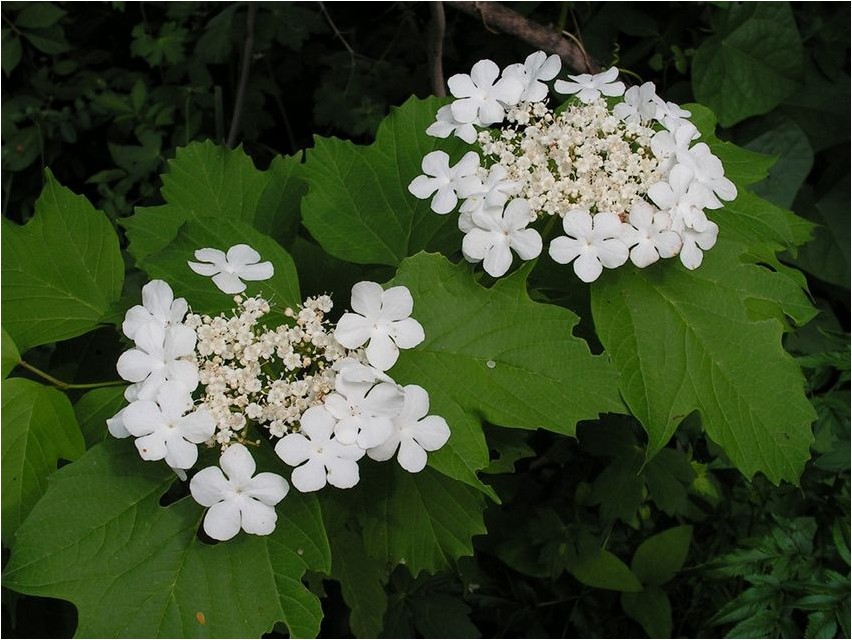
Viburnum sargent is one of the plants of the family called honeysuckle, in Latin the name of this plant will be as follows: Viburnum sargentii Kochne.
As for the name of the Sargent viburnum family itself, in Latin it will be: Caprifoliaceae Juss.
Description of viburnum sargent
Viburnum sargenta is a fairly large shrub, the height of which will be about two to three meters, and the diameter at the base of the largest shoots is approximately five centimeters. It is noteworthy that the wood of this plant is endowed with a very characteristic odor. The bark will be colored in light colors; on old trunks it will be finely flaky, but on young branches it will be smoother. With the exception of only the uppermost leaves, the leaves will be three-lobed with rather sharp lobes and irregularly coarse-toothed edges. Such leaves can be either completely bare or pubescent. The flowers will be of two kinds: the marginal ones are large and reach two centimeters in diameter, they are flat and sterile, painted in bright white tones. The remaining flowers will be fertile, cup-shaped and quite small in size. The fruits of viburnum sargent are colored in light red tones, they are bitter, but at the same time also juicy.
Flowering of viburnum sargent begins in the second half of July, and fruit ripening will occur at the end of September. Under natural conditions, this plant is found in China, Korea, Japan, Transbaikalia, as well as in the following regions of Russia: in the Amur region, Sakhalin, the Kuril Islands, Primorye and the Khabarovsk Territory. It should be remembered that this plant is not only very decorative, but also a rather valuable honey plant.
Description of the medicinal properties of viburnum sargent
Viburnum sargent is endowed with quite valuable healing properties, and it is recommended to use the fruits, leaves, bark and flowers of this plant for medicinal purposes. The aerial part of Viburnum sargent contains saponins, and the bark contains catechins and tannins. The leaves will contain alkaloids, flavonoids, phenolcarboxylic acids and their derivatives. The fruits of this plant contain vitamins C and K, fatty oil, organic acids, carbohydrates, alkaloids and anthocyanins.
A decoction made from the bark of the Sargent’s viburnum can improve uterine tone and also have hemostatic, anti-inflammatory, vasoconstrictive, and diuretic effects. The fruits of the Sargent’s viburnum can be used as a valuable diuretic and cardiotonic.

The flowers, fruits, and leaves of this plant have hemostatic properties. It should be noted that the fruits are quite edible, and the dried fruits can be used to make jam and jelly. Furthermore, these fruits also serve as food for both domestic and wild animals.
For diarrhea, use the following remedy based on the Sargent’s viburnum: to prepare this remedy, take fifteen to twenty grams of crushed bark per two cups of boiling water. Let the mixture steep for four hours, then strain thoroughly. Take one to two tablespoons of this remedy three to four times daily. The following remedy can be used as a sedative: to prepare this remedy, take three tablespoons of crushed leaves and one tablespoon of flowers per 300 milliliters of boiling water. Let the mixture steep for an hour or two, then strain. Take half a glass of this remedy three times daily.
For flu, pour water over the bark of common viburnum at a ratio of one part to twenty parts, then boil the mixture for half an hour and strain. Take this remedy fifteen to thirty milliliters three to four times daily.
Viburnum. Types





