Attractive porcupine
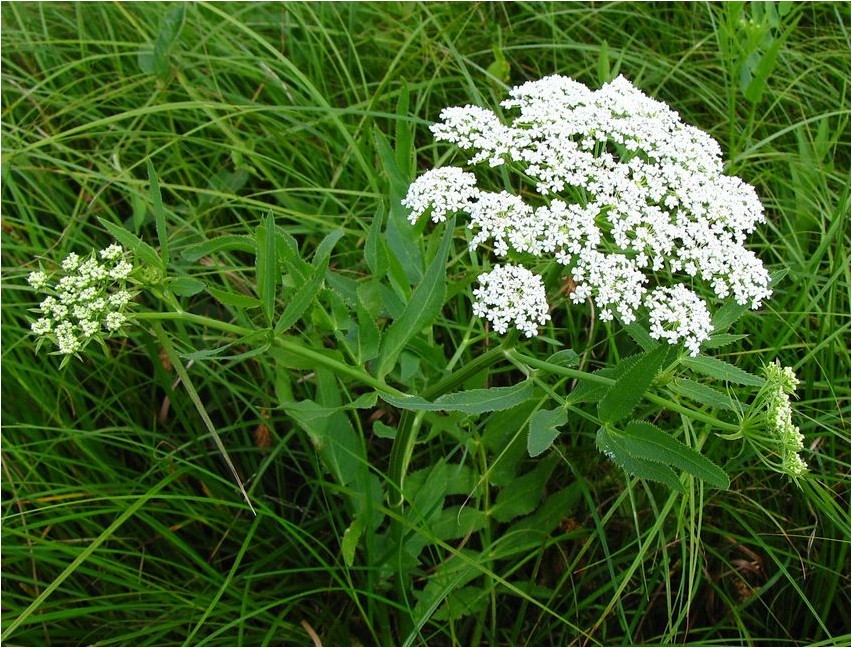
The attractive porcupine is one of the plants of the family called Umbellaceae; in Latin the name of this plant will be as follows: Sium snave Walt. (S. cicutifolium Schrenk.).
As for the name of the attractive porridge family itself, in Latin it will be like this: Apiaceae Lindl. (Umbelliferae Juss.).
Description of the attractive porcupine
The attractive porridge is a perennial herbaceous plant, the height of which will fluctuate between sixty and one hundred and eighty centimeters. The roots of this plant are numerous, rather thick and short. The stem of the attractive porridge will be bare, ribbed, straight and strong, and the underwater leaves, in turn, will be double-pinnate. The lower leaves of this plant are on rather long petioles, which will be hollow inside. The leaf blade of the attractive porcupine is endowed with from three to nine pairs of leaflets, while the upper leaves will be sessile, and the umbrellas, in turn, are endowed with from eight to twenty bare rays. The involucre of this plant will be multi-leaved, and the petals will be colored white. The fruit of this plant is round in shape, its length is approximately three millimeters, and it will be slightly flattened on the sides.
The flowering of the attractive porridge occurs in the period from June to July. Under natural conditions, this plant is found in the Eastern Arctic, all regions of Eastern Siberia with the exception of the Yenisei region, as well as in the following regions of the Far East: Sakhalin, Kamchatka, Primorye and Amur region. For growth, this plant prefers damp meadows, low-lying swamps, marshy shores of lakes, rivers and streams.
Description of the medicinal properties of the attractive porridge
The attractive porridge is endowed with very valuable healing properties, and it is recommended to use the roots of this plant for medicinal purposes. The presence of such valuable healing properties should be explained by the content of kaempferol, coumarins, essential oil, quercetin and polyacetylene compounds in this plant.
It should be noted that the roots of the attractive porridge in North America are eaten by Indians, while the leaves serve as a very aromatic spice. It is noteworthy that the root extract of this plant is endowed with very valuable antitumor properties.

As for Chinese and Tibetan medicine, here this plant is very widespread. The medicine of these countries recommends using a decoction prepared on the basis of the roots of the attractive porridge as a valuable diuretic, while in complex herbal infusions this plant will act as an anticancer agent.
As a diuretic, it is recommended to use the following remedy based on this plant: to prepare such a very effective healing remedy, you will need to take eight grams of crushed roots of the attractive gracilis in about one glass of water. The resulting healing mixture should be boiled over fairly low heat for about six to seven minutes, then left to infuse for about one hour, after which this healing mixture is filtered very carefully. Take the resulting medicinal product based on the attractive graciatus three times a day before meals, one-third or one-fourth of a glass. If used correctly, such a healing remedy based on the attractive graciatus will be very effective and the positive effect will be noticeable quite quickly.





