Soursop
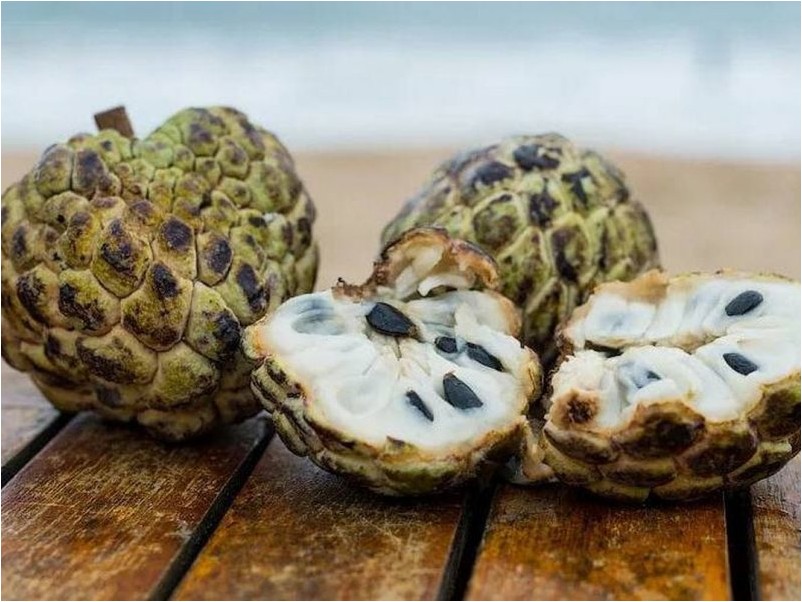
Soursop (Latin: Annona muricata) is a fairly common plant belonging to the Annonaceae family.
Description
Soursop is a small fruit tree growing up to nine meters tall. All young shoots are invariably pubescent, and the smooth, shiny, and wonderfully fragrant leaves are light green underneath and dark green above.
Single, conical-shaped flowers of soursop grow on short stalks, which can be located not only on branches but also on trunks.
The fruits of this plant are incredibly juicy, multi-leaflet fruits with a rather strong turpentine aroma. They are the largest fruits of all the crops belonging to the Annonaceae family. The width of the fruits often reaches fifteen centimeters, and their length can vary from ten to thirty-five centimeters. Their weight ranges from four and a half to seven kilograms. Unripe fruits typically have dark green skin, but as they ripen, the skin gradually begins to yellow and become covered with rather thick spines. The dense flesh of soursops resembles cotton wool and boasts a pleasant creamy-white color. It is sweet and sour and smells strongly of strawberries. Each fruit also contains black, poisonous seeds.
Where it grows
In its natural state, soursops grow on numerous Caribbean islands (including Bermuda and the Bahamas), as well as in several South and Central American countries (from Peru and Argentina to southern Mexico). In all these countries, this plant has long been cultivated. It can be found at altitudes up to 1, 150 meters above sea level.
The soursop has also been successfully introduced and has thrived in southern China, Oceania, Australia, and India, as well as in some countries of Southeast Asia. Uses

After peeling, these fruits can be eaten fresh. Ideally, they should be mixed with a small amount of sugar, as they have a slightly tart flavor. For a delicious dessert, simply flavor the pulp with cream or milk. The extract from these fruits has also found its way into a wonderful tea flavoring. The pulp of soursops is also an excellent addition to ice cream and is often used to make sorbets, cakes, jellies, jams, and rich syrups.
In countries where soursops grow, their fruits are used to make wonderfully refreshing juices and drinks (freshly squeezed juice is combined with milk and sugar). Furthermore, the juice is often fermented, producing a low-alcohol drink similar to cider in both aroma and color.
Regular consumption of these fruits helps maintain healthy intestinal flora and promotes the elimination of toxins from the body. These fruits can help normalize gallbladder and liver function, as well as combat gout, rheumatism, and arthritis. For those with hypertension, they can quickly lower blood pressure.
Recently, Latin American scientists discovered that soursops also contain substances with powerful anti-cancer properties. The juice of this plant, renowned for its pronounced diuretic effect, is widely used to treat kidney ailments, and the astringent taste of the unripe fruits is excellent for diarrhea and dysentery. The bark and roots of the plant are often used as a nerve agent for fishing. An infusion of ground seeds is renowned for its powerful emetic effect, and the oil obtained from the seeds helps quickly get rid of lice. The leaves are equally popular: a decoction made from them is an excellent antispasmodic and sedative, and the crushed leaves are considered an excellent poultice for various skin ailments.
Contraindications
Soursop is not a fruit to overindulge in, as excessive consumption can lead to the development of the extremely unpleasant Parkinson”s disease. The seeds should not be eaten at all, as this can lead to very serious poisoning, as they are toxic. If the plant”s juice accidentally gets into the eyes, it can even cause blindness. Furthermore, soursop should not be consumed during pregnancy, and it is also important to remember that it can cause allergic reactions. Soursop, soursop, annona, guanabana, graviola, exotic fruit
Soursop