Banana
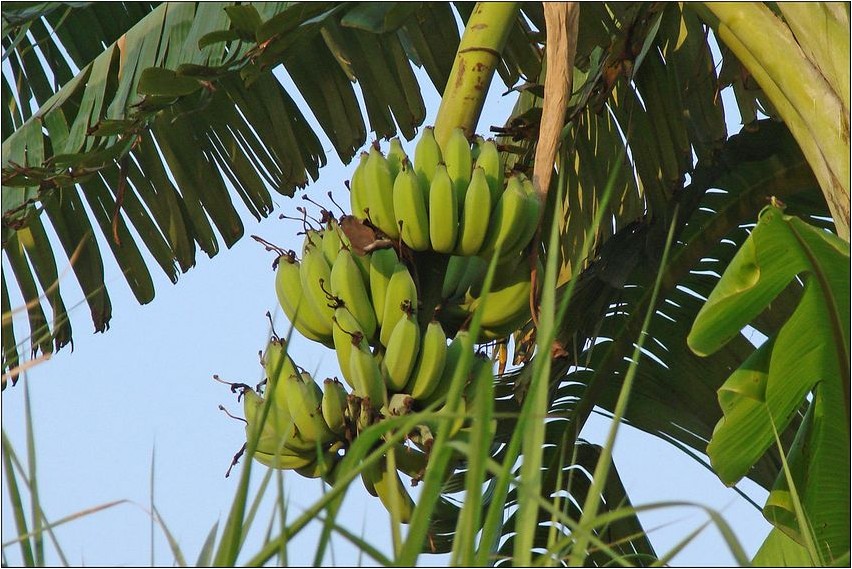
Banana (lat. Musa) is not a spreading tall palm tree, not a fruit tree with clusters of yellow fruits, but just a giant herbaceous perennial plant.
The genus of plants called “Banana” is one of three genera of the Banana family (Musaceae) and unites in its ranks about seven dozen species that like the climate and soil of Southeast Asia. Although today Bananas grow not only there.
What”s in your name
There is no exact origin of the genus names. There are only a few versions that refer to the languages of the peoples who were the first to taste the tasty and healthy fruits. We do not know what these people associated plants and their fruits with, and therefore we simply repeat after them in Latin “Musa”, and in Russian “Banana”. By the way, the pronunciation of “banana” can be heard in many countries around the world, but “Musa” is very close to the name of the fruit in Arabic.
Description
When you see huge and heavy bunches of ripe bananas on the shelves of eastern markets, you imagine very strong branches of a powerful tree that are able to hold such weight. But nature played a trick on the human imagination by creating Banana as a herbaceous plant.
She came up with a very interesting way of creating a strong “trunk” from the leaves of a plant, masterfully positioning them relative to each other. Each new leaf, born from the plant’s vagina, is provided with strong support from the existing leaves, which carefully embrace the newborns. Thus, leaf after leaf, up to six meters long and up to 1 meter wide, give birth to what botanists call a “false stem,” the strength of which is not inferior to tree trunks, and the height can reach 15 meters.
Although the Banana has a trunk, or rather a stem. But it is very short and prefers to hide in the soil, revealing only leaves to the surface of the earth. The stem is an intermediary between the above-ground parts of the plant and the root underground part, which is also very powerful, because it has to work hard to turn the herbaceous plant into something like a tree.

The herbaceous plant can grow in enormous size thanks to its powerful roots, year-round summer and its longevity. It is much more difficult for our tall perennials, such as Burdock, Hogweed, Elecampane, to turn into trees, since in winter they have to take a break in growth.
In favorable conditions, Banana grows very quickly, giving its fragrant fruits within 10-11 months. But, before the plant reveals its “multi-story” fruits to the world, a peduncle rushes from the underground stem to the heavens, protected by the “false stem” from the vicissitudes of fate. The peduncle is crowned with an inflorescence — a brush consisting of white, purple, or three-colored flowers, arranged in tiers on the peduncle.
That’s why the fruits form a multi-tiered banana cluster. Each banana is a multi-seeded berry, which sometimes contains much more seeds than tender, aromatic pulp. But this picture can be observed in wild bananas. Bananas grown by humans are devoid of seeds for the sake of fleshy pulp, and therefore such plants are propagated only by vegetative means.
The above-ground part of the Banana, similar to the giant Bamboo grass, dies after fruiting, giving way to young shoots growing from the roots.
Multifunctional plant
The herbaceous plant Banana gives people not only nutritious fruits that replace bread in many countries, but also allows you to use its roots, false stem and leaves for many household purposes.
As for the roots of the plant, they are quite edible and were used by people as food where banana fruits were stuffed with seeds so densely that eating them was not appetizing.
False stem, like reed, is an excellent building material for lightweight fishing rafts and other devices for fishermen. Furniture is made from them, in particular, rugs that replace bulky and hard chairs. The famous “Manila hemp”, from which unsinkable sea cables and ropes are made, is a derivative of the Banana false stem.
Banana leaves serve as food utensils.