Capulin
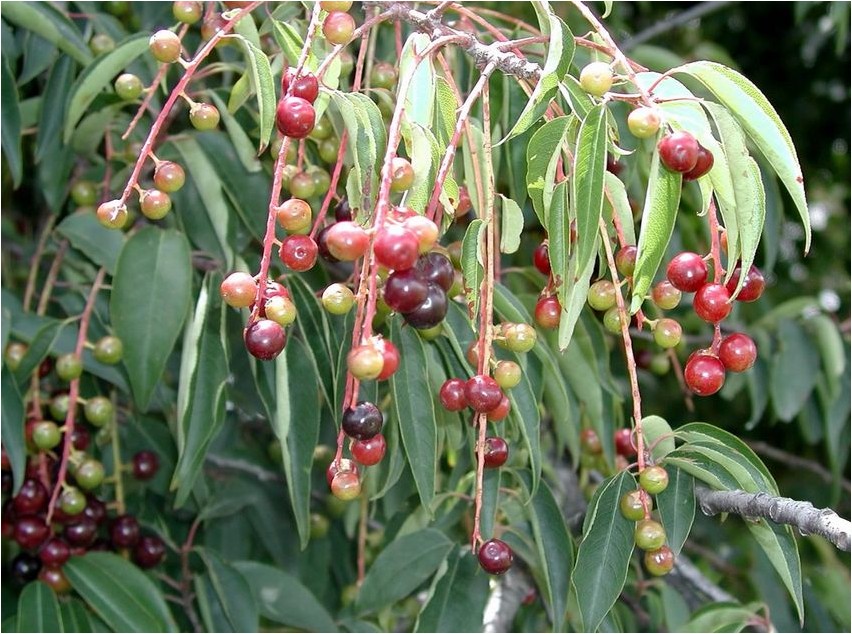
Capulin (lat. Prunus salicifolia) is a deciduous tree belonging to the Rosaceae family.
Description
Capulin is a small deciduous tree whose height ranges from twelve to fifteen meters. The oval-lanceolate leaves of this plant are quite pale below and glossy above. As a rule, they reach a length of six to eighteen centimeters.
White capulin flowers are collected in rather pretty brushes. Flowering trees are very reminiscent of bird cherry in appearance, and the flowers smell almost the same. By the way, European tourists often mistake this tree during its flowering period for bird cherry.
Reaching one or two centimeters in diameter, the rounded fruits are covered with delicate and smooth reddish or almost black skin. And inside each fruit there is one fairly large seed and a sweet-sour juicy pulp of pale green color.
The seeds of some fruits have a bitter taste — this is due to the high content of amygdalin (which disintegrates in water with the simultaneous release of hydrocyanic acid, a toxic substance). It is strictly not recommended to eat them.
In Mexico, capulin blooms from January to March, and the fruits ripen in July and August. And in Guatemala, flowers begin to appear in January, and flowering continues until May. As for the harvest, it is harvested in Guatemala from May to September. And in El Salvador, the fruiting period covers the period from December to April.

Where does it grow
Capulin is a plant native to Guatemala and Mexico. However, it has long been cultivated in many other parts of Central America: for example, in Bolivia, Colombia, Ecuador and Peru. And in 1924, this culture was introduced to the Philippine plateaus.
Application
Ripe capulin fruits are eaten either raw or stewed. In addition, they are often fermented into alcoholic beverages. And among the local population of Central America, a very unique dessert made from this fruit has gained unprecedented popularity. To prepare it, capulin berries are first poured with milk, and then cinnamon and vanilla are added to the resulting mixture.
Capulin flowers are widely used in medicine—a decoction is an excellent remedy for headaches. A syrup made from the fruits is recommended for various upper respiratory tract ailments and shortness of breath. A decoction of capulin leaves is used as an anti-inflammatory, astringent, and excellent antipyretic. Incidentally, it is used not only internally but also externally. An infusion of the leaves is often prescribed as a sedative for neuralgia and colic. It is also an excellent antispasmodic.
An infusion or decoction of capulin bark, which has an antiseptic effect, is excellent for a number of infectious ailments, including conjunctivitis. The inflorescences of this plant contain substances with analgesic properties.
To replenish calcium, capulin is best eaten fresh—heating converts this element into an insoluble form, making it virtually impossible to absorb. Typically, the fruits of this plant can be stored in the refrigerator for seven to nine days.
The wood of the kapulin is also highly prized—its yellowish sapwood with striking red streaks is also exceptionally durable, making it suitable for making magnificent furniture.
Cultivation
Kapulin is quite undemanding and grows quickly, filling vast spaces. This plant begins to bear fruit in the second year after germination.
Turnkey frame house, KAPULIN project





