Hair-like ossicle
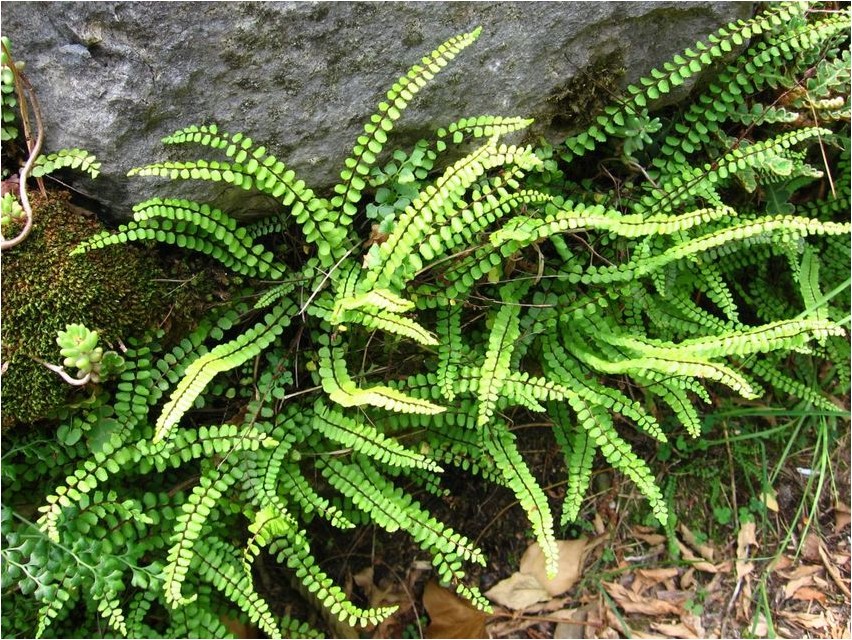
The hairy ossicle is one of the plants of the family called Cloveaceae; in Latin the name of this plant will be as follows: Asplenium trichomanes L.
As for the name of the hairy bone family itself, in Latin it will be: Caryophyllaceae Juss.
Description of the hair-like bone
The hairy ossicle is a perennial herbaceous plant. The rhizome of such a plant is turfy, and it is covered with blackish films that have a false vein. The leaves of the hair-like ossicle will be feathery, bare, and the petioles and stem will be painted black. Such petioles and stem will be shiny, the segments are sessile or endowed with a very short petiole, they will be obovate-roundish or truncated, sometimes they can also be endowed with an ear. Along the edge, such leaves of the hair-shaped bone are crenate, often they can be incised up to one quarter or incised crenate, sometimes they can also be small.
Under natural conditions, this plant is found in the European part of Russia, Crimea, Ukraine, Kazakhstan, Central Asia and the Caucasus. As for the general distribution, this plant can be found in China, Europe, North and South America. The plant prefers rock cracks to grow; most often this plant will grow in the shade of a forest.
Description of the medicinal properties of the hairy bone
The hairy bone is endowed with very valuable healing properties, and it is recommended to use the aerial part of this plant for medicinal purposes. Grass should be harvested either in summer or autumn. In this case, the grass should be rinsed very thoroughly in water and dried. However, the grass of this plant can also be used fresh.
The hair-like bone is endowed with very valuable antipyretic, anti-inflammatory effects, and also has the ability to normalize the menstrual cycle.

A decoction prepared from the hairy bone is recommended for use at elevated temperatures in children, menstrual irregularities and leucorrhoea. The fresh herb of this plant is used for the following diseases: bites of poisonous soils, burns, bleeding of traumatic origin, carbuncles and boils. For this use, it is recommended to chop the hairy ossicle grass well and apply it to the sore spot.
For elevated temperatures and colds, it is recommended to use the following remedy based on the hairy ossicle: to prepare such a remedy, you will need to take fifteen grams of crushed dry grass per glass of water. The resulting mixture should be boiled over fairly low heat, and then this mixture based on this plant is left to be carefully filtered. Take the resulting product one-fourth of a glass, and children are given one tablespoon three times a day.
For menstrual irregularities and leucorrhoea, it is recommended to use the following remedy based on the hairy ossicle: to prepare such a remedy, you will need to take five grams of crushed dry grass of this plant per glass of water. The resulting mixture should be boiled for five minutes over fairly low heat, and then this mixture is left to infuse for one hour and filtered thoroughly. Take the resulting remedy before meals three to four times a day, one-third of a glass. It is important to remember that you should strictly follow all the rules for preparing and taking such a healing remedy based on the hairy bone.





