Hyssop
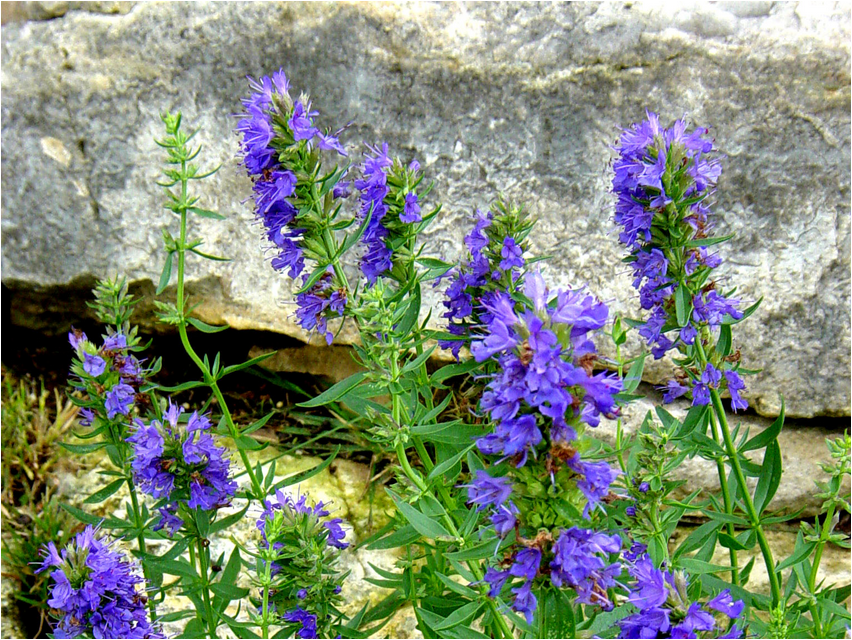
Hyssop (lat. Hyssopus) is a genus of herbaceous plants and subshrubs of the family Lamiaceae, or Lamiaceae. Natural range – Western Asia, North Africa, Southern, Eastern and Central Europe.
Nowadays, the plant is widely cultivated almost throughout Europe, Russia and the USA. The Mediterranean and southern regions of Asia Minor are considered to be the homeland of hyssop.
Characteristics of the culture Hyssop is a herbaceous plant or highly branched subshrub 20-90 cm high. The root system is taproot, the main root is woody. The stems are numerous, twig-like, glabrous or covered with short hairs, tetrahedral, often lignified at the base. The leaves are sessile, lanceolate, entire, arranged oppositely, the edges are slightly bent. Compared to the lower leaves, the upper ones are much smaller.
The flowers are white, pink or dark blue, collected in oblong, false whorled or spike-shaped inflorescences, sitting in the axils of the leaves. The calyx is two-colored: purple on the outside, light green on the inside. The corolla is two-lipped. The fruit consists of four dark brown nuts, triangular-ovoid in shape. Seeds will remain viable for 3-4 years.
Hyssop blooms in July-September. The fruits ripen in August-September. All parts of the plant have a pleasant aroma and a bitter, spicy taste. Hyssop is cold-resistant and drought-resistant, practically not affected by pests, since it contains essential oils that repel insects.
Growing conditions
Hyssop is undemanding in terms of growing conditions. Prefers moderately moist, calcareous, loose soils. The culture does not accept saline and swampy areas, as well as areas with close groundwater. Hyssop is light-loving and develops best in open, sunny places. Light shading is not prohibited. The plant does not tolerate continuous shade.

Reproduction and planting
Hyssop is propagated by seeds, cuttings and dividing the bush. Seeds do not need preliminary preparation. Most often, crops are grown by seedlings. Seeds are sown in greenhouses or seedling boxes in March. The seeding depth is 0. 5-1 cm. Shoots appear on the 10-12th day. Seedlings are planted in open ground at the end of May; the distance between plants should be 40-45 cm. Sowing hyssop directly into the ground is not prohibited.
With the seedling method, in the first year of life the plants grow rather slowly; in subsequent years, the subshrubs branch strongly, bloom and bear fruit profusely. Every 3-4 years, hyssop is divided. Young divisions grow quickly and produce a good harvest of fresh greens. Cuttings are rarely carried out. cuttings are cut in the spring and planted for rooting in a substrate consisting of fertile soil and sand. The cuttings take root fairly quickly.
Care
Care consists of weeding, loosening the rows, watering and fertilizing. Intensified weed control is carried out in the first year of life; in the future, weeding will not take much time. Hyssop is neutral about pruning. After each cutting, fertilize with complex mineral fertilizers. In central Russia, plantings are covered with a thick layer of peat, humus or sawdust. The crop is extremely rarely affected by diseases and pests, but prevention is necessary.
Harvest
The harvest of greenery intended for drying is carried out during the period of mass flowering. It is at this moment that plants contain the maximum amount of essential oil. Young shoots of hyssop can be collected throughout the season. With proper care and favorable growing conditions, hyssop quickly grows a powerful green mass.
Application
Hyssop is widely used in folk medicine and cooking. Dry and fresh young shoots of hyssop have a pleasant sage aroma. They are used as a seasoning to flavor first and second courses, as well as cold appetizers. Hyssop is also used to make a special tonic drink intended for older people. Hyssop is suitable for preparing stews, zraz, marinades, potatoes, salads and various fish dishes.
Dry leaves and oil of hyssop are used in perfumery. In terms of its healing effects, hyssop has some properties similar to sage. It is useful for constipation, dyspepsia, anemia, bronchitis and intestinal catarrh. Often dry parts of plants are used for bronchial asthma, neurosis, rheumatism, excessive sweating, chronic colitis, flatulence, angina pectoris and other diseases. Infusions and decoctions of hyssop are used to wash the eyes, as well as gargle and rinse the mouth.





