Dzhusai
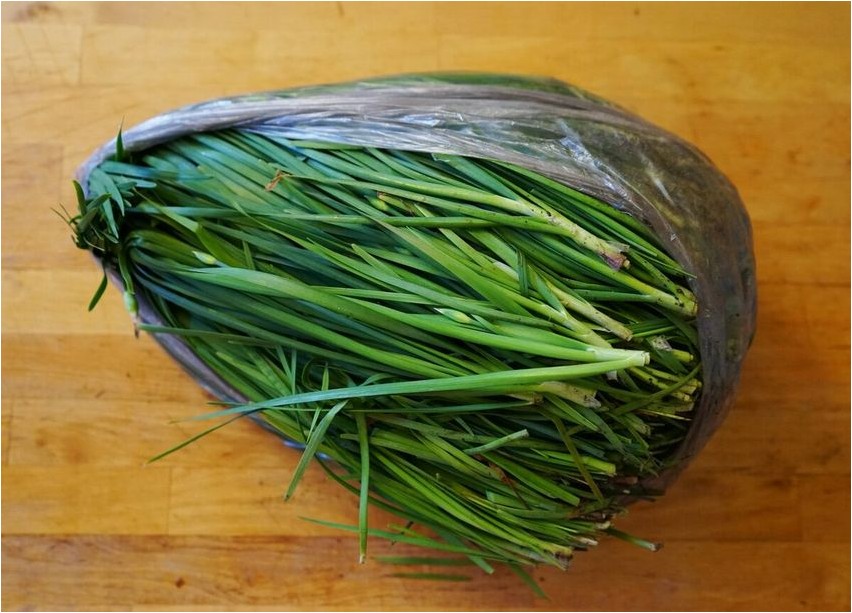
Dzhusai (Latin: Allium ramosum) is a perennial and incredibly frost-hardy plant from the Onion family, also known as fragrant onion, Chinese onion, or branched onion. It is sometimes also called wild onion.
Description
Dzhusai, with its very thin and long green shoots, bears a resemblance to the well-known young garlic. Incidentally, its taste and very unusual aroma are also very reminiscent of garlic.
Dzhusai”s narrow, linear bulbs are firmly attached to the rhizomes and reach a diameter of 0. 8 to 1. 5 cm, while the flower stalks reach a height of sixty to seventy centimeters.
Dzhusai”s white, star-shaped flowers have intricate central veins on their petals, tinged with violet tones, and are gathered into very dense, beautifully spherical umbels. The flowers of this plant boast an incredibly delicate and unusually pleasant scent. Before the first flowers begin to bloom, all the inflorescences are covered with a unique “sheath.”
This plant was first discovered by numerous peoples in distant China and welcoming Mongolia, and now this interesting plant can be found in virtually every corner of the globe.
Where it grows
Currently, the beautiful dzhusai grows in Eastern and Western Siberia, in the mountains of Central Asia, and in the southern regions of the Altai Mountains.

Uses
Fresh, spicy dzhusai is often added not only to appetizers and salads, but also to first and second courses. This onion makes an excellent addition to almost any side dish. It also makes incredibly delicious sauces, all thanks to its amazing aroma. Incidentally, not only the dzhusai shoots, but also its flowers and bulbs are edible. As for the shoots, they are excellent pickled and preserved in various ways. And the leaves of dzhusai can always be frozen, allowing them to be used in cooking all year round. Moreover, frozen leaves perfectly retain not only their unrivaled flavor but also all their beneficial properties.
Dzhusai is often found in popular dishes such as Korean salads, the beloved lagman, and others. It is also widely used in stir-fries. It is also sometimes added to soups or dumplings—dzhusai is a wonderful way to add variety to absolutely any dish.
All parts of healthy jusai are very rich in ascorbic acid, so this vegetable will be an ideal assistant in the difficult task of strengthening blood vessels and immunity. In addition, it has a very beneficial effect on cartilage tissue, as well as on the hematopoietic and endocrine systems.
In Tibet, all parts of the fragrant onion are used — all kinds of healing potions are prepared from them, which perfectly help to cope with gastroenteritis, bronchitis and a number of other ailments. They also help with nervous tension and even amenorrhea. And in the East, jusai is quite actively used for gastritis, exhaustion and neurasthenia.
It is good to use this plant for various colds, as well as for tuberculosis and bronchitis. It will also help people with heart problems. And fragrant onions have a pronounced hematopoietic, powerful choleretic and mild diuretic effect.
Jusai juice is actively used in folk medicine — it helps to quickly relieve inflammation resulting from insect bites or nettle burns.
Often, the fragrant bow is also used as a very unique decoration — its thin leaf arrows folded into stars really do an excellent job of decorating any personal plot.
Contraindications
It is not advisable for people with individual intolerance to eat Jusai. It is contraindicated for all those suffering from extremely unpleasant cholelithiasis, as well as for patients with cholecystitis or pancreatitis and various inflammatory diseases of the gastrointestinal tract.