Beetroot
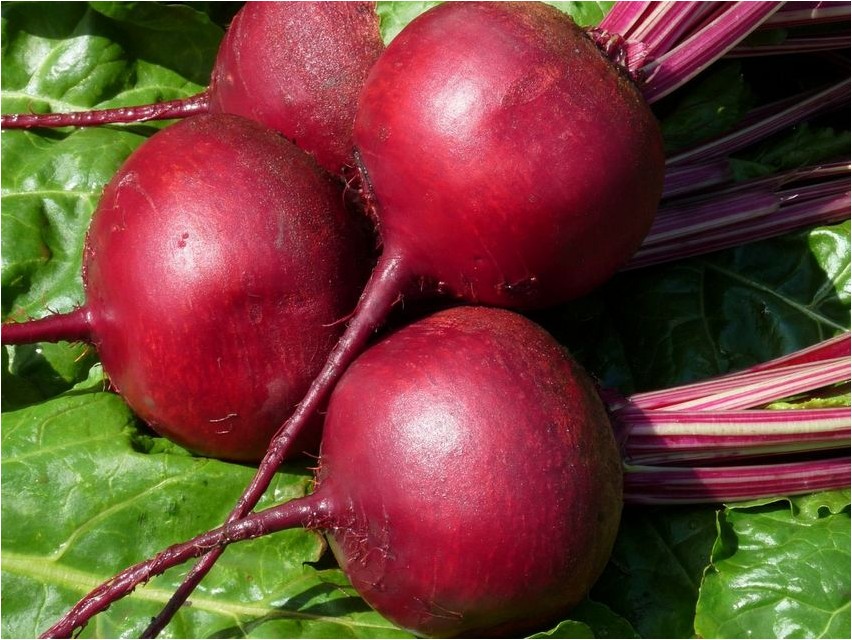
Beetroot (Beta vulgaris) is a plant that belongs to the Chenopodiaceae family and has a two-year development cycle. Homeland — Mediterranean.
General characteristics
Known since ancient times, beets occupy an important place among vegetables. This is easy to explain — first of all, the excellent taste of the plant, ease of cultivation, storage and preparation.
In the first year, beets form a rosette of leaves. The root vegetable comes in different shapes and colors of varying intensities. The shape of beet roots is conical, cylindrical and flat. The outer skin also varies — from burgundy to purple and black. The pulp can be the usual raspberry-red, burgundy, purple, etc.
The leaves are entire, petiolate with an ovoid (heart-shaped) plate. In the second (but it also happens in the first) year of life, the plant develops a flowering stem. Flowering starts two months (or a little less) after planting and lasts a month or two. Beet flowers are quite small and bisexual. The seeds are located in inflorescences — each from one to seven pieces. The seeds are round and smooth.
Rules of care

Temperature Beets are very thermophilic. Moreover, it grows well even in salty soils. Seeds germinate at a fairly low temperature of 3-5°C. Of course, the optimal temperature is much higher and is approximately 21-25°C. At lower temperatures, seeds germinate slowly, some seedlings die, and the number of plants that form flower stalks prematurely increases. An adult plant can survive short-term frosts. When frost occurs, the plant dies. At the same time, the best temperature for plant development is from 16 to 25°C.
Soil. The most suitable soil for beets is medium loamy soil. Beets grow worst in acidic soils. A good option is to grow the plant as a second crop after organic fertilizers have been used (early cabbage, cucumbers, potatoes). If there is insufficient fertility, only humus can be added to the soil (3-4 kg per meter). In spring, mineral fertilizers are added to the soil.
Watering. Beets need increased moisture at absolutely all stages of growth. So special attention should be paid to regular watering. At the same time, the plant is not well suited to waterlogged, cold and acidic soils, which are low in nitrogen and potassium. Aerated soils with a slightly alkaline or neutral soil solution are much better. At the start of the growing season there is an increased need for nitrogen, at the end of the growing season — potassium. As for phosphorus, it is evenly absorbed throughout the entire vegetation period.
Sowing. Beets are sown in spring, about a week after carrots. You can sow in the summer. The seeding rate is approximately 1. 1-2 g per square meter. The seeds are planted to a depth of three to four centimeters. On the eve of sowing, the seeds need to be soaked in warm water (for a day).
Care consists of constant watering, removing weeds, loosening, fertilizing (organic fertilizer is used at the stage of 3-4 true leaves). When 2-3 true leaves of the plant appear, the beets are thinned out (leaving 2. 5-3 cm between seedlings), after two to three weeks — by 6-8 cm, choosing young root crops for consumption. When root crops begin to form, you can feed the plants with mineral fertilizers.
Harvest. Beets must be harvested before frost. It is better to organize the storage of root crops in the basement (without layering with sand). Storage features also depend on the variety.
To obtain seeds, root crops are planted early in the spring and immediately watered. The seed plants are removed after the seeds turn brown.