Ropeman
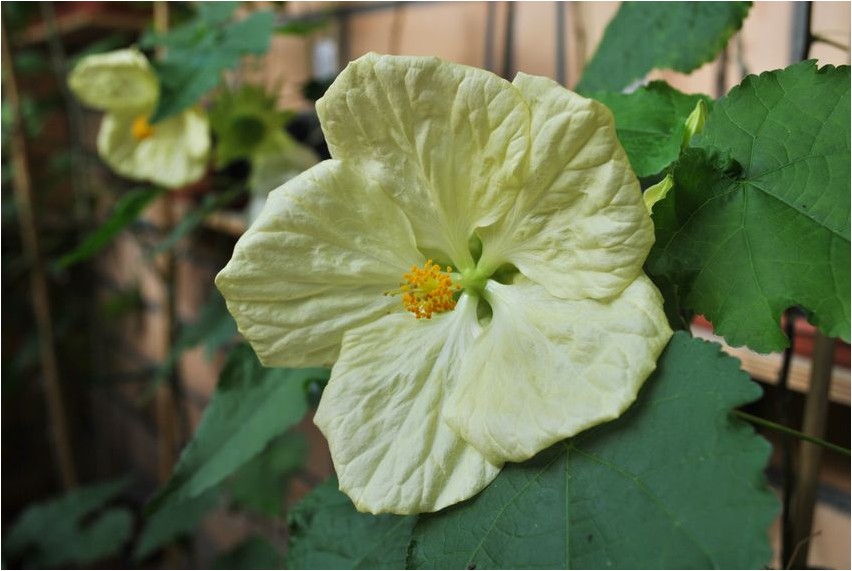
Kanatnik, or Abutilon (lat. Abutilon) is a genus of annual and perennial herbs, subshrubs, shrubs and low-growing trees of the Malvaceae family.
The genus contains more than 200 species. The natural range is South America, Africa, Australia, India, China and the Hawaiian Islands. Various types of abutilone are cultivated as ornamental and agricultural crops. Some species are used to obtain plant fiber used to make twine, rope and burlap. The species cultivated on the territory of the Russian Federation is the Theophrastus Rope.
Common types and their characteristics
*Hybrid abutilon (lat. Abutilon hybridum) — the species is represented by spreading evergreen shrubs up to 1. 5 m high, which are a hybrid of American species — striped or variegated abutilon (lat. Abutilon pictum) and Abutilon Darwin (lat. Abutilon darwinii). The bark is brown. The leaves are five-lobed, softly pubescent, green, long-petiolate, maple-shaped, up to 12 cm long. The flowers are bell-shaped, drooping, and, depending on the variety, can be white, red, golden or burgundy in color.
*Abutilon vitifolium (lat. Abutilon vitifolium) — the species is represented by shrubs up to 2. 5 m high. The shoots are softly pubescent. The leaves are large, green, velvety, three- or five-lobed, deeply serrated, up to 15 cm long. The flowers are broadly bell-shaped or wheel-shaped, lavender-blue with dark veins, collected in terminal racemes of 3-4 pieces. Flowering occurs in May.
*Abutilon theophrasti (lat. Abutilon theophrasti) — the species is represented by annual herbaceous plants with a tap-type root system. The stem is erect, branched at the top, pubescent, up to 250 cm long. The leaves are large, serrated, broadly ovate, entire, covered with soft hairs over the entire surface. The flowers are yellow or yellow-orange, oval in shape, collected in paniculate or racemose inflorescences.
*Spotted abutilon (lat. Abutilon pictum) — the species is represented by shrubs with shortened soft shoots. The leaves are long-petiolate, green, glabrous, heart-shaped, palmately lobed, equipped with white spots along the periphery. The flowers are bell-shaped, golden-yellow with red veins, solitary, sitting in the axils of the leaves on long stalks. This variety blooms in August-September.

Growing conditions
Ropewort is an undemanding plant and doesn”t require any special growing conditions. Ropewort thrives in well-lit areas with filtered light; light shade won”t harm it. When grown indoors, pots should be placed near a west- or east-facing window. In summer, ropeworts can be placed outdoors or on a balcony, but should be brought indoors during heavy rain or wind.
It should be remembered that unfavorable conditions for indoor plants can cause leaf and flower drop. The optimal temperature for growth and development is 22-25°C; a sharp drop in temperature will adversely affect the plant”s health. Ropewort prefers light, loose, fertile, slightly acidic or neutral soil. Ropeworts do not tolerate dry, compacted, saline, or waterlogged soils. Propagation and Planting
Abutilon is propagated by seeds and vegetatively, more specifically, by semi-woody cuttings. Seed propagation is suitable for non-variegated varieties. Sow seeds in early spring (March-April) in seedling trays filled with a light substrate with added sand and peat. Plant at a depth of 0. 5-0. 6 cm. The room temperature should be between 18-20°C (64-70°F). Water and ventilate the seedlings regularly. Seedlings emerge in 2-3 weeks. With optimal growing conditions and careful care, the seedlings will bloom the same year.
When propagating abutilon by cuttings, the planting material is taken from the tips of young shoots. Each cutting should contain three leaves; buds are pinched out before planting in the substrate. The cuttings are rooted in containers with damp sand and peat. They can also be rooted in water, with a temperature ranging from 20 to 22°C (68 to 72°F). Cuttings take 4-5 weeks to root, after which they are planted in 7-8 cm diameter containers for further growth. The plants are transplanted outdoors the following year.
Care
Water abutilons regularly and generously, especially during prolonged periods of dry weather. When growing indoors, water as the soil dries out; in winter, the frequency and amount of watering are significantly reduced. Fertilizing abutilons is essential; at least three applications of mineral and organic fertilizers are required per season.
To ensure shrubs and semi-shrubs have a lush and attractive crown, formative pruning is performed in the spring. Sanitary pruning is also required, and is performed both in the spring and fall. Some abutilon species require staking. If all conditions are not met, plants are often attacked by various pests, such as whiteflies, mealybugs, aphids, thrips, and scale insects.
Theophrastus ropewort. Florists may find it useful.