Juniper
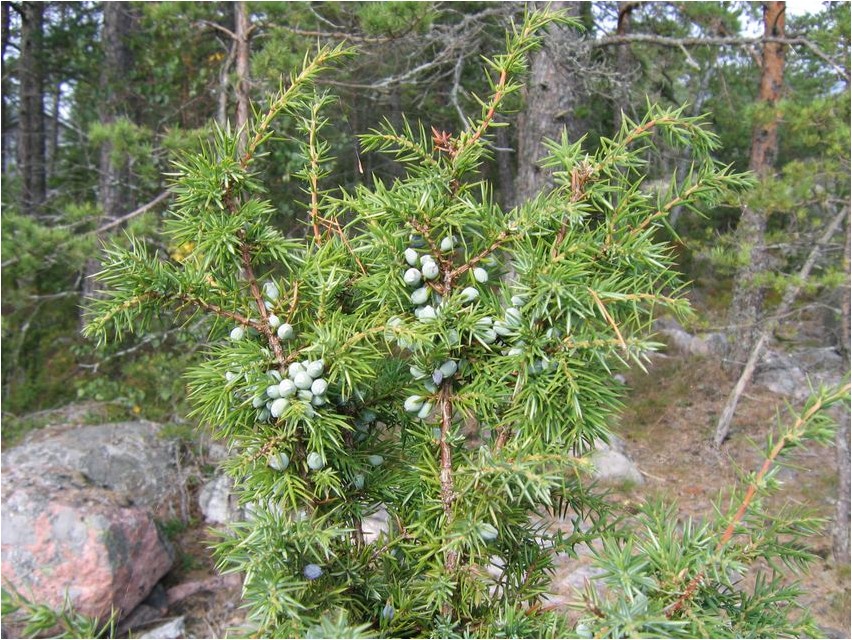
Juniper (lat. Juniperus) is a genus of coniferous trees and shrubs of the Cypress family. The plant is known as heather. In some sources you can find the name — archa.
Under natural conditions, juniper grows in the Northern Hemisphere from the subtropics to the Arctic. The East African juniper species (lat. Juniperus procera) is distributed only in Africa. Typical places of growth are mountains, forests, rocky slopes, cliffs, etc.
Characteristics of culture
Juniper is an evergreen shrub or tree with bare buds, often surrounded by shortened and appressed leaves, with the exception of stone fruit juniper (lat. Juniperus drupacea) — the buds of this species are covered with numerous dense scales. The leaves are linear-lanceolate, needle-shaped, collected in whorls or opposite in pairs, equipped with a stomatal stripe on top, as well as a divided or undivided midrib, tightly pressed to the runs. Female spikelets can be of three types, male spikelets are single or collected in several pieces in the axils of leaves on last year”s shoots. The cone is spherical, with fleshy, tightly closed scales, does not open, contains 1-10 seeds.
Growing conditions
Juniper is an unpretentious crop, characterized by high drought-resistant properties. The plants are undemanding to soil conditions, but develop best in light, loose, nutritious and moderately moist soils. Juniper does not tolerate saline, heavily waterlogged and swampy soils. Cold tolerance varies among all species. There are species that develop normally only in subtropical climates.
Reproduction and planting
Juniper is propagated by seeds, cuttings and layering. Cuttings are considered to be the most effective method of propagation. The percentage of rooting of cuttings depends on the duration of the procedure, the type and type of cut material.
Common juniper and some of its varieties are distinguished by their high rooting ability (usually up to 70-90%). Juniper cuttings can be carried out at any time of the year, but gardeners recognized spring cuttings (April-May) as the best. Root cuttings in greenhouses or under film.

You can also harvest cuttings in February, but after the severe frosts have subsided. The optimal rooting temperature is 23-25C; elevated temperatures are undesirable. The substrate must be moistened regularly, at least once a day. Diffused light is an important condition for normal rooting.
Cuttings of creeping junipers must be planted in the ground at an angle, the rest — vertically. The cuttings take root after 50-70 days, after which they are planted in a permanent place. Treating cuttings with growth stimulants significantly improves rooting results, especially for semi-lignified cuttings cut from annual growths.
Planting of seedlings is carried out in April-May. It is recommended to purchase seedlings from specialized nurseries. The optimal age of the seedling is 3-4 years. Planting is done with a clod of earth. The planting hole is prepared in the fall or two to three weeks in advance. After planting, the soil in the tree trunk area is watered abundantly and mulched with withered leaves or peat with a layer of 10-12 cm. Further care of the young plant consists of frequent spraying of the crown.
Care
In general, junipers are not picky. They need rare watering and fertilizing, as well as systematic weeding of the tree trunk area. Fertilizing is carried out in early spring. For these purposes, you can use nitroammophoska and rotted organic matter. The culture has a positive attitude towards spraying the crown; this procedure is carried out once every 10-15 days.
Junipers do not need pruning, although sanitary pruning is not prohibited. Junipers with a spreading crown are recommended to be tied with twine for the winter, otherwise heavy snow may break the branches. Only young plants (the first 1-2 years) need shelter for the winter. The crop is resistant to diseases and pests, so there is no point in preventive treatments.