Welsh Onion
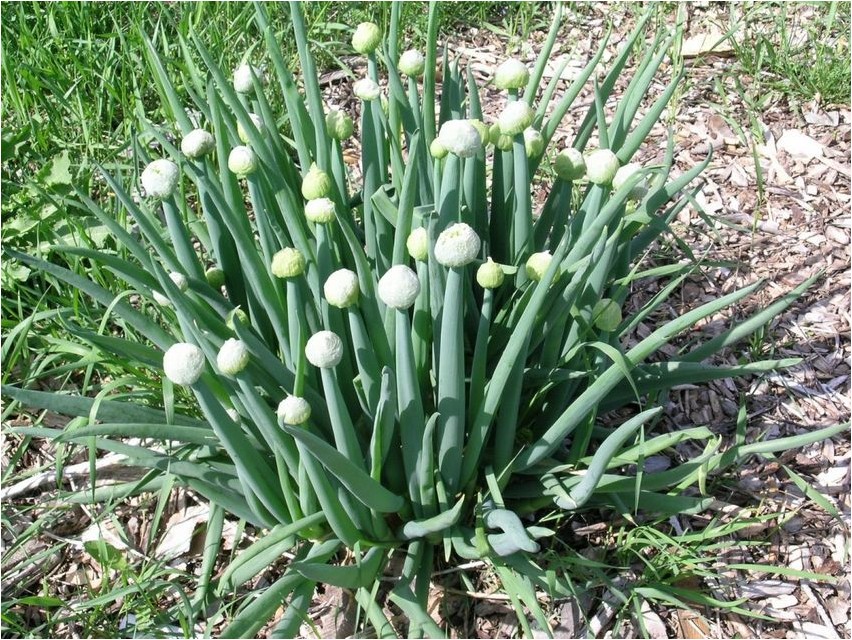
Welsh onion (Latin: Allium fistulosum) is a perennial vegetable crop belonging to the onion family. Other names include hollow onion, sand onion, and Chinese onion.
Description
Welsh onion is a herbaceous plant with an inconspicuous bulb and hollow foliage, reaching a length of 50 cm. It has a well-developed root system, and during growth, or more precisely toward the end of the growing season, numerous small bulblets form. The bulb is inconspicuous and can be cylindrical.
The plant”s hollow flower stalks, up to 1 m long, bear rounded, multi-flowered umbels composed of small, inconspicuous flowers. Welsh onion blooms in the first ten days of June, and the seeds sprout in the second ten days of July. Welsh onion is a frost-hardy crop suitable for cultivation in many regions of Russia. Welsh onions also love moisture, but they can withstand short-term droughts without harm.
Cultivation Features
Welsh onions grow best in loose, highly fertile, moist, cultivated, and permeable soils. Loamy and sandy loam soils are optimal. Damp, salty, waterlogged, and poor soils are unsuitable for growing the crop. Welsh onions love the sun and are recommended for growing in open areas. Solanaceae are good predecessors for this crop.
Propagation Details
Welsh onions are propagated by seed and division. They can be grown as annuals or perennials, but not for more than three years, as yields decline by the third year, and the plants develop tough, unpalatable foliage.
Welsh onions are sown at various times. Fall sowing is acceptable. Summer sowing is also possible. The soil for growing the crop is prepared two weeks in advance, dug to a full spade depth, and fertilized with mineral fertilizers and organic matter.

Sow the seeds in rows, leaving 20-22 cm between rows. After sowing, water thoroughly and apply mulch. Onion seedlings can be seen after 15-20 days.
Care Procedures
If Welsh onions are grown as annuals, thinning is not necessary. Otherwise, the foliage will be tough and not very palatable. Perennial cultivation requires thinning, leaving 5 cm between plants. Thin the plants when the fourth leaf appears, and apply the first fertilizing at the same time, along with loosening the soil. Subsequent fertilizing is done after cutting the leaves.
Harvesting
Harvesting the leaves is done once they reach a height of 40 cm. Harvesting is then done after a couple of weeks. Typically, up to five cuttings are made per season. During the fall harvest, the crop is pulled from the soil, cleared of soil, and stored in a dry place.