Parthenocissus
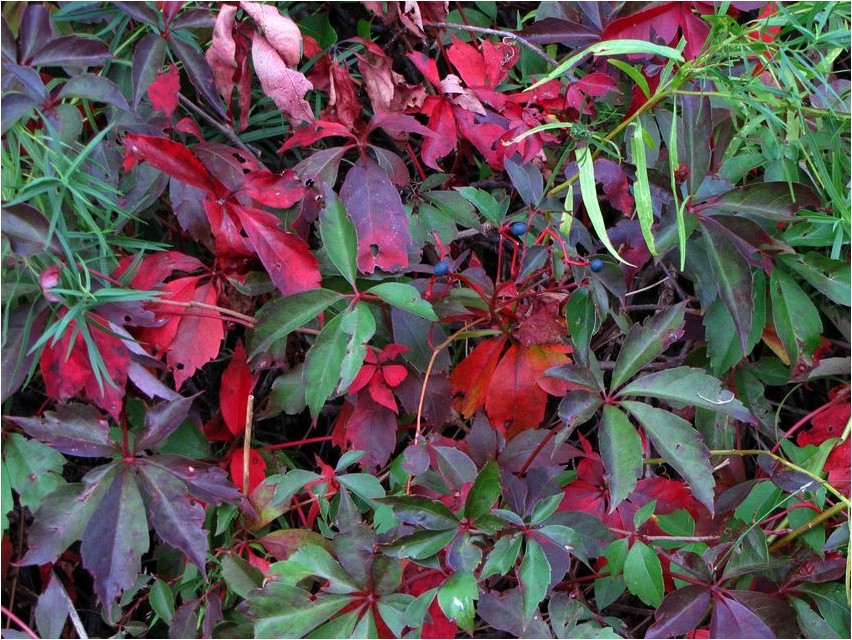
Parthenocissus (lat. Parthenocissus) is a woody plant from the Grape family, quite widely known as maiden grapes.
Description
Parthenocissus is a deciduous shrub vine that rises upward with the help of expanding tendrils in the form of suckers. The height of this plant often reaches twenty to thirty meters.
The leaves of Parthenocissus are three-lobed, compound and palmate. All of them sit on fairly long petioles, and in the summer they are green in color, and in the fall they turn burgundy.
The inflorescences of this plant are corymbose and rather inconspicuous — each inflorescence includes from three to five miniature greenish flowers. And the inedible fruits of parthenocissus look like dark blue berries. All berries are collected in clusters and reach a diameter of five to seven millimeters. And their ripening usually occurs either at the end of summer or at the very beginning of autumn.
In total, the genus includes about ten species.
Where does it grow
The homeland of parthenocissus is considered to be the Himalayas, East Asia and North America. Quite often this beautiful plant can be seen in Russia.

Usage
Parthenocissus is an ideal plant in all respects for decorating gazebos, fences, building walls and pergolas. Over the course of a year, this handsome guy can grow from one and a half to two meters!
When planting parthenocissus near walls, you should try to maintain a distance of one meter, while it is quite acceptable to use supports up to ten meters high.
Parthenocissus also produces a rather interesting effect when decorating all kinds of horizontal surfaces. In addition, it is incredibly good as a ground cover plant!
As for the berries of this plant, despite the fact that they are inedible for humans (but these berries are not poisonous at all!), they are excellent food for birds in the winter.
Growing and care
Despite the fact that parthenocissus is a light-loving plant, it also tolerates shading quite well. It can grow in any soil, but well-drained, loose and fertile soils are most preferable for its cultivation. And parthenocissus is so unpretentious that it adapts to almost any conditions without much difficulty and easily tolerates transplantation at absolutely any age! And it is also extremely gas and smoke resistant!
Two-year or three-year-old seedlings are placed in planting holes with a mixture of sand, peat compost and leaf soil, taken in a ratio of 1:2:2. In addition, each hole is additionally equipped with drainage made of sand or crushed stone.
Parthenocissus is watered moderately, three or four times per season. This plant also requires mulching and loosening; in addition, parthenocissus requires fertilizing twice a year.
Throughout the entire season, the plant requires sanitary pruning, during which it is necessary to eliminate dry and damaged shoots; in addition, no one has canceled the fight against excessive growth — in this case, proper control is also necessary.
The rhizomes of parthenocissus tend to become bare; therefore, if they become visible, they need to be sprinkled with fresh soil and the graceful vine should be lightly hilled. As a rule, this is done in the fall in preparation for the winter season.
Parthenocissus reproduces equally well both by cuttings or root suckers, and by layering or seeds. In this case, propagation by layering is the simplest option. And sometimes parthenocissus also acts as a rootstock when grafting various varieties of cultivated grapes!





