Yarrow
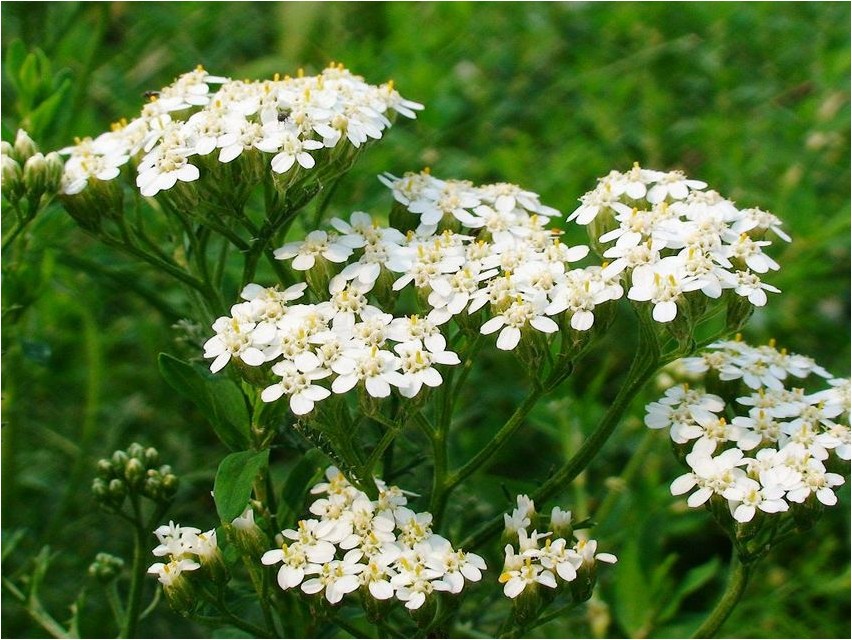
Yarrow (lat. Achillea) is a perennial plant of the Asteraceae, or Asteraceae, family. Yarrow is native to the temperate zones of the Northern Hemisphere.
Currently there are about 150 species.
Characteristics
Yarrow is a herbaceous plant, less often a subshrub, with an erect, heavily leafy stem, slightly curved at the soil surface. The height of the plant varies from 20 to 150 cm. The leaves are pinnately dissected, incised or whole, toothed, arranged alternately.
The flowers are small, collected in baskets or dense corymbose inflorescences, reaching 10-15 cm in diameter. Tubular flowers are yellow or white, the marginal ones are white, pink, yellow or red. The fruit is an oblong achene. The seeds are oval or ovoid, flattened.
Common types

*Noble yarrow (lat. Achillea nobilis) – the species is represented by perennial plants with an erect stem up to 50 cm high. The leaves are oblong-elliptical in shape, twice pinnately dissected. The flowers are yellowish-white, collected in corymbose inflorescences. Flowering begins in the second decade of June and lasts 25-35 days.
*Common yarrow (lat. Achillea millefolium) – the species is represented by perennial plants with a straight stem up to 80 cm high. The leaves are pinnately dissected. The flowers are small, collected in inflorescences-baskets. Reed flowers are pink or purple, tubular flowers are brown. Blooms for 40-45 days.
*Yarrow ageratofolia (lat. Achillea ageratifolia) – the species is represented by perennial plants with an erect stem up to 15-20 cm high. The leaves are green with a grayish-silver tint, pinnately dissected. Flowers are solitary. Flowering begins in July.
*Meadowsweet yarrow (lat. Achillea filipendulina) – the species is represented by plants 100-150 cm high. The leaves are green, pinnately dissected. The flowers are small, collected in inflorescences-baskets, reaching 5-7 cm in diameter. Meadowsweet yarrow blooms in July – August.
*Yarrow ptarmica, or consumptive grass (lat. Achillea ptarmica) – the species is represented by compact bushes with a creeping rhizome. The stem is heavily leafy, reaches a height of 80-100 cm. The leaves are green, entire, small, linear-lanceolate in shape, with a serrated edge, arranged alternately. The inflorescences are umbellate, simple or double, pearl-white in color. Flowering begins in July and lasts 30-35 days.
Growing conditions
Yarrow prefers well-lit areas, but Achillea ptarmica thrives in shaded areas. Well-drained, loose, poor, slightly moist soils with a high lime content are preferred. Yarrow does not tolerate compacted soils.
Propagation and Planting
Yarrow is propagated by seeds, cuttings, and division. Seeds are sown directly into open ground in early spring, but this method is rarely used by gardeners. Division is considered the most common and effective propagation method. Either a portion of the plant or a portion of the rhizome is separated from the plant and planted in soil until rooting occurs. The divisions can be planted directly in their permanent location. To preserve the varietal characteristics, self-seeding should be avoided.
Care
Yarrow responds well to mineral fertilizers. In hot weather, plants require moderate watering. Tall varieties require support. Dividing and replanting yarrows is done every three to four years. Urgent replanting is indicated by bare spots in the center of the clump, where dense and tangled roots are strangling each other.
Applications
Yarrow is used in group plantings, while low-growing varieties are used in alpine gardens, rock gardens, and rustic gardens. Tall varieties are sometimes planted individually at the back of mixed borders and other types of flower beds. Yarrow is a highly ornamental plant that can be grown in areas where cultivated plants do not thrive.
Some yarrow species are widely used in folk medicine. The healing properties of this plant have been known since ancient times. Yarrow is used as a hemostatic agent and for the treatment of other ailments. Ornamental (garden) yarrow from seed without picking – from sowing to flowering





