Guanabana
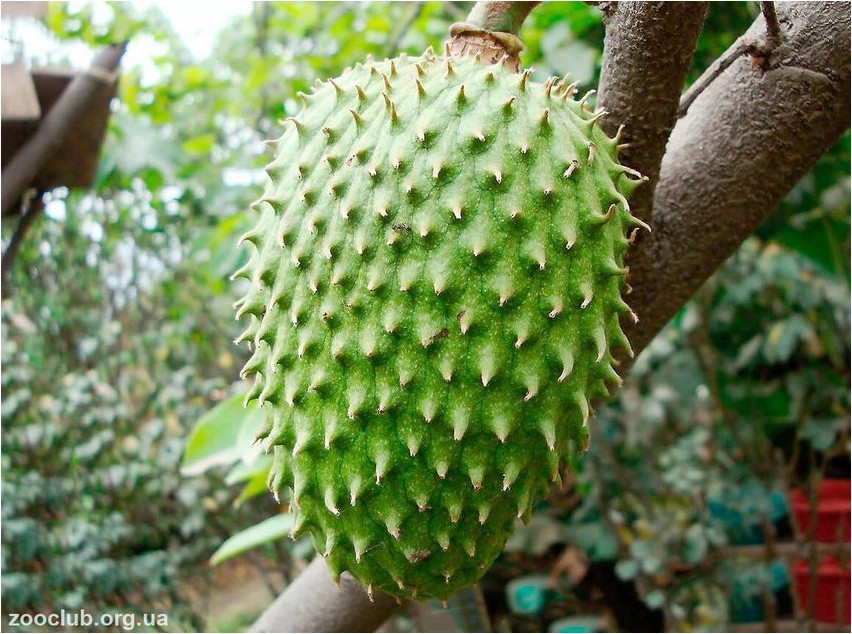
Guanabana (Latin: Annona) is an exotic fruit, often called soursop, soursop, or graviola.
Description
Guanabana is a highly prized evergreen fruit tree, belonging to the Annonaceae family. Each tree can reach eight to ten meters in height, and its crown is rich with glossy, smooth, green, aromatic leaves. Young shoots are quite heavily pubescent.
Single flower stalks form on short peduncles, which later grow directly on the tree trunks. Each flower has six petals and is characterized by a conical shape.
The oval or round guanabana fruit weighs between three and seven kilograms. Their bright green surfaces with a slight yellowish tint are densely studded with soft, bell-shaped shoots. The largest specimens can reach twenty centimeters in width and ten to forty centimeters in length. The skin is thin, yet surprisingly dense.
The guanabana”s flesh is white and quite soft, somewhat cotton-like, and divided into several distinct segments. Its flavor is vaguely reminiscent of lemonade with an incredibly pleasant tartness, or raspberry and lemon. Ripeness is easily determined—the fruit can be easily pressed between your fingers. It”s also important to know that the black seeds contained within the guanabana”s flesh are highly poisonous, so eating them is strictly prohibited! Ignoring this rule can result in severe poisoning. If the juice from these seeds gets into the eyes, a person can even go blind.
It”s also worth mentioning that this plant is related to ylang-ylang, which is why their aromas are somewhat similar.

Where it grows
You can try guanabana while traveling to Argentina, Peru, Mexico, or the Bahamas. It is also occasionally found in Bermuda, as well as in China (primarily in the southern part of the country), India, and Australia.
Uses
Guanabana fruits are actively used to obtain all kinds of extracts, nectars and juices. Their surprisingly juicy pulp makes them an ideal raw material for making sherbets, jams, jellies and even sweets, and milkshakes with guanabana juice are incredibly popular in Latin America. In addition, with the addition of these fruits, excellent desserts are obtained, and they go perfectly with whipped cream or ice cream. These fruits are very rich in vitamins C and B, which help cure neuralgic pathologies and are excellent for various ailments of bone tissue. In addition, each fruit contains such valuable elements as calcium and phosphorus, as well as magnesium and iron, which saturate the human body with beneficial amino acids. A fairly high percentage of carbohydrates and proteins makes guanabana one of the most nutritious fruits. By the way, with its help it will not be difficult to cure dystrophy in young children.
Valuable macro- and microelements in guanabana help prevent the development of cancer, and also actively promote healing in diseases of the liver and large intestine, arthritis, rheumatism and gout. As for guanabana extract, it will serve well against various viral ailments. It also helps get rid of skin fungus and malaria.
Contraindications
Excessive consumption of these fancy fruits can lead to the development of Parkinson”s disease. And for pregnant women it is better to avoid them altogether — the excess calcium content in guanabana can have a detrimental effect on their body.