Teassus hairy
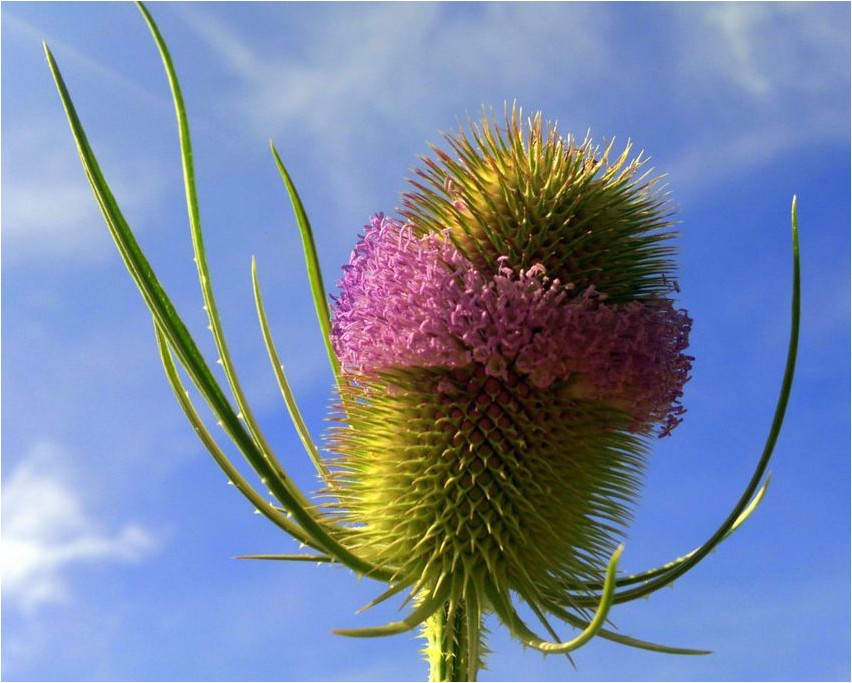
Hairy teasel is one of the plants of the family called teasel family; in Latin the name of this plant will be as follows: Dipsacus pilosum L.
As for the name of the teasel family itself, it will be like this: Dipsacaceae Juss.
Description of teasel
Hairy teasel is a biennial herbaceous plant, the height of which can vary between fifty centimeters and one and a half meters. The stem of this plant is straight, almost bare and also grooved and faceted. The leaves of this plant will be thin-skinned and ovoid in outline, with the lower leaves on longer petioles. The uppermost leaves of hairy teasel are often endowed with two small lateral lobes, as well as a terminal large one. The head will be spherical in shape, it is located on a bristly stalk, its diameter will be about twelve to seventeen centimeters. Actually, such a head will initially be drooping, the involucre leaves are leathery and lanceolate. The veil is devoid of grooves and will be jagged at the top. Hairy teasel flowers are colored yellowish-white, they are funnel-shaped, and their length will be about eight to ten millimeters. The stalks of this plant are colored in dark purple tones. This plant blooms in July, and the fruits begin to ripen in August.
Under natural conditions, this plant is found in Crimea, Moldova, the Caucasus, as well as in Western Siberia, namely in the Irtysh region and near Barnaul. This plant can also be found in the Carpathians and the Dnieper region of Ukraine, and besides this, also in the European part of Russia: in the Volga-Don, Black Sea and Lower Don regions. To grow, hairy teasel prefers shady places, bushes and forest edges.
Description of the medicinal properties of teasel
Hairy teasel is endowed with quite valuable healing properties; it is recommended to use the flowers, inflorescences, roots and grass of this plant for medicinal purposes. The concept of grass includes the leaves, inflorescences and stems of hairy teasel. The plant contains alkaloids and iridoids.
As for traditional medicine, a decoction of the roots of this plant is widely used. This remedy should be used for syphilis and pulmonary tuberculosis. For calluses, snake bites and hemorrhoidal cones, you should use a decoction or paste of the leaves, roots and inflorescences of this plant. This agent is used as an anesthetic. Preparations of the aerial part of teasel are endowed with a diuretic, anti-inflammatory effect, and will also stimulate the function of the respiratory system, blood circulation and the cardiovascular system.

A decoction prepared from the herb of this plant is recommended to drink for fevers, cancer and stomach ulcers, and in the form of compresses this remedy is good for skin cancer. A decoction prepared from the inflorescences of this plant is recommended for use in rheumatism. It is noteworthy that the experiment showed that the sum of triterpenoids is low-toxic and can short-term reduce blood pressure. As for the textile industry, here this plant is used to create lint on fabrics.
For stomach ulcers, it is recommended to use the following remedy, for the preparation of which you will need to take one teaspoon of crushed roots in one glass of water. this mixture should be boiled for five minutes, and then left to infuse for one hour, after which it is important to strain this mixture very carefully. It is recommended to take this remedy approximately two to three tablespoons three times a day.





