Rambutan
Rambutan (Latin: Nephelium lappaceum) is a tropical fruit tree belonging to the Sapindaceae family.
Description
Rambutan is a mostly evergreen tree with a spreading, rather lush crown, reaching a height of twenty-five meters. The average height of trees ranges from four to seven meters. The paripinnate leaves of the plant are ovate or oval, leathery leaflets, numbering from two to eight.
The miniature rambutan flowers are gathered in highly branched inflorescences located at the tips of the branches.
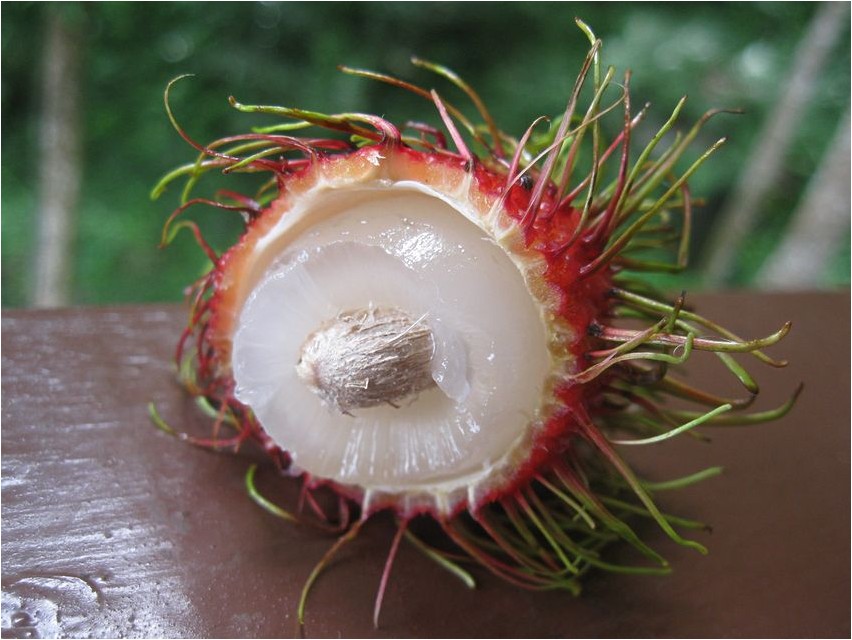
The oval or round fruits of this crop, ranging in size from three to six centimeters, form clusters, each containing up to thirty fruits. As the fruits ripen, their color changes first from green to yellowish-orange, and then to bright red. All fruits are covered with a fairly thick skin that easily separates from the flesh. The surface of the rambutan skin is densely covered with rather tough, hook-shaped hairs of light or dark brown shades, often up to two centimeters long.
The flesh of the rambutan fruit is very aromatic, gelatinous, and sweet and sour. Incidentally, its taste is reminiscent of green, sweet grapes. The flesh can be slightly reddish or white. The oval, fairly large, brownish seeds often reach three centimeters in length.
Rambutan has a huge number of subspecies—it can be both evergreen and deciduous, and its fruits can be either fruit-shaped or berry-shaped.

Where it grows
Rambutan is a plant native to Southeast Asia, so it grows primarily in countries in this region. It is also quite common in Malaysia, Thailand, and as far away as Indonesia. Rambutan is equally popular in the Caribbean, Central America, sunny Australia, and hot Africa. The most extensive plantations are found in the Philippines, Indonesia, India, Sri Lanka, and Cambodia.
Rambutan is one of the most beloved fruits in Thailand—Thais tell many beautiful legends about this fruit, and in August, they even celebrate a festival dedicated to it.
Uses
Rambutan fruits are eaten primarily fresh. They are also often canned with sugar.
Rambutan is very rich in niacin, proteins, carbohydrates, various microelements, and vitamin C.
Raw rambutan seeds are poisonous, but when roasted, they become quite edible. And the oil from these seeds is actively used in the production of candles and soap.
The leaves, bark and roots of this crop are quite widely used for the production of fabric dyes and in folk medicine. And in Malaya, the dried bark of this tree can be found in literally every pharmacy.
Raw fruits are great for treating diarrhea and dysentery. The fragrant pulp of rambutan helps stop the process of improper digestion of food and has a calming effect on the inflamed intestines. Also in many countries, this fruit is used as an anthelmintic. And the leaves of these amazing trees are used to make poultices that help get rid of headaches.
Growing
Rambutan can be grown at home as a houseplant. The ideal temperature for this would be approximately eighteen to twenty degrees, and the lighting should resemble tropical rambutan, that is, this plant should have approximately the same amount of light and dark time (about twelve hours).