Sea Squill
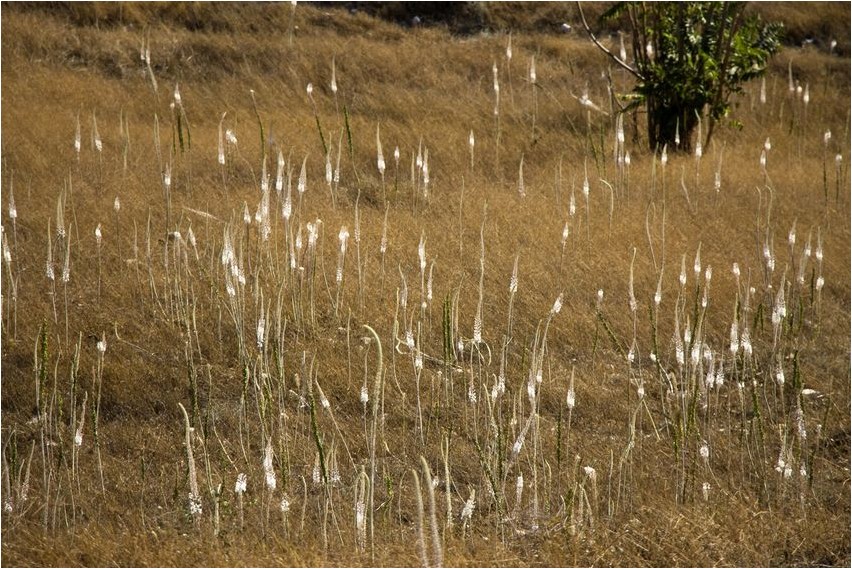
Squill is a member of the lily family, and its Latin name is Urginea maritima (L.) Baker (Scilla maritima L.).
The Latin name of the sea squill family is Liliaceae Juss.
Description of Sea Squill
Squill is a perennial herbaceous bulbous plant with thick, fleshy roots that reach up to four centimeters in diameter. The bulbs of this plant are very large, weighing approximately one to three kilograms. The bulbs are fleshy, pear-shaped, and can range in color from reddish-brown to white with a slight yellowish tint. The leaves of this plant are succulent, smooth, and broadly lanceolate, and are approximately forty to fifty centimeters long. It’s noteworthy that at the end of the growing season, these leaves will dry up. The flower stalk of this plant is usually erect. This stalk develops in an adult plant until the leaves appear. It will be cylindrical in shape and approximately one meter tall. The upper part of the sea squill stalk bears numerous greenish-white flowers, as well as six-membered corolla-shaped perianths and stamens, the length of which will be equal to half the petal. The three-locular ovary of the sea squill bears a style ending in a divided stigma. It’s noteworthy that the fruit will contain numerous small, round seeds. These seeds are oval in shape, but sometimes they may narrow, become pointed at the apex, and widen at the base. Sea squill seeds are quite flattened, with unevenly rounded edges. Sea squill blooms from June to August. This plant grows primarily on the southern coast of France, the coasts of Portugal and Spain, Italy, Greece, Morocco, Algeria, the northern coast of Africa, and the Atlantic islands.
Description of the medicinal properties of sea squill
Sea onions are endowed with very valuable healing properties. The presence of such valuable healing properties should be explained by the content of lysate, saponins, tannins, sitosterol, stigmasterol, scyllarene A, scyllifeoside, scylliccryptoside, phytoncides, chelidonic and citric acids in the bulbs of this plant.
White sea onion is used in the form of infusions, powder, decoctions, extracts, pills and extracts. An infusion prepared from the bulbs is indicated for use in chronic and acute circulatory failure, in heart failure in patients with coronary sclerosis, as well as in circulatory disorders due to mitral valve insufficiency.
Red bulbs will be endowed with a very effective raticidal effect and are recommended for use as a means to combat rats. Rats will eat the bulbs and then they die pretty quickly. To make up such mixtures, you can take one hundred grams of grated red sea onion, fifty grams of fat and fifty grams of flour. It is also possible to make butter, which will then be spread on bread: to prepare such butter based on this plant, you will need to take six hundred grams of flour, four hundred grams of water and fifty grams of lard. This whole mixture should be mixed, and then you will need to finish off the grated red onion in a volume of five hundred grams. Such products are very effective in the fight against rats.

Squill. Plant Directory
https://www. youtube. com/watch? v=wRLdHx_d2LU
Sea onion





