Oblique bow
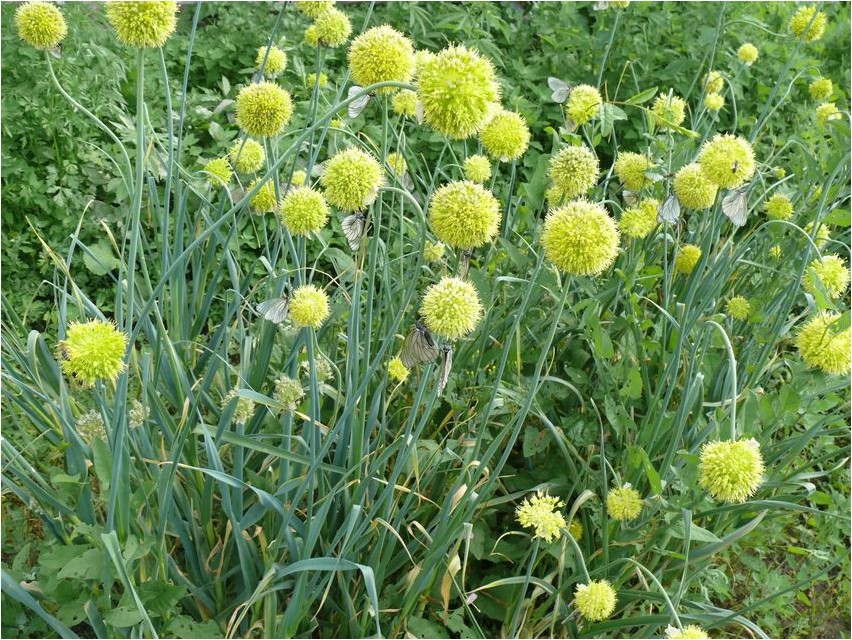
oblique onion (lat. Allium obliquum) is a representative of the Onion genus of the Onion family. Represented by perennial herbaceous plants.
Under natural conditions it grows in the European part of Russia, Central Asia, Mongolia, China and Romania. Typical places are meadows, steppes, woodlands and forest slopes. Other names for the plant are mountain garlic or uskun onion. The oblique onion is a relatively new and promising type of onion, which is used primarily for decorative purposes.
Characteristics culture
Oblique onion is a herbaceous plant with a single oblong-ovate bulb, reaching 2-4 cm in diameter. The bulb shells are red-brown, attached to a vertical rhizome. The stem is quite dense, powerful, up to 150 cm high, covered up to the middle with smooth vaginal leaves. The leaves are linear, tapered towards the apex, usually flat, up to 2 cm wide, smooth along the edge. The flowers are collected in spherical thick umbrellas. The perianth is greenish-yellow, ovate-bell-shaped. The tepals are obtuse or sharp, boat-shaped, up to 5 mm long. The fruit is a triangular capsule containing 3-5 seeds. The seeds ripen in early August.
Nowadays, oblique onions are successfully cultivated on personal plots; they are considered one of the earliest representatives of the Onion family, since the first leaves appear immediately after the snow melts. Oblique onions are especially useful at the age of three, since it is at this time that they contain the maximum amount of nutrients. High-yielding culture, from 1 sq. m you can get up to 1. 5 kg of leaves.
Growing conditions
Oblique onion is unpretentious and grows in one place for up to 10 years. It is necessary to take into account the fact that when plantings are thickened, the leaves become smaller, so it is necessary to regularly thin them. Sites for cultivation are preferably sunny with loose, light, fertile soils. Oblique onions are undemanding to moisture conditions.
Sowing
Sowing onions is carried out in early spring or autumn under cover. Pre-winter sowings give good results. When sowing in spring, a harvest of fresh and juicy leaves can be obtained only after a year. In the first year of life, plants are recommended to be grown in special nurseries, where they are sown. By the end of the growing season, the plants form 2-3 thread-like leaves about 15-20 cm high with an octagonal cross-section and a bulb with a diameter of 0. 6-0. 8 cm. In the second year, the oblique onion forms up to 7-8 flat leaves, some specimens begin to bloom. The division of the bulbs occurs at 3-4 years.

Application
Leaves and other parts of onion are used in cooking; they are added to vegetable salads and other dishes, as well as for canning. The plant has a garlicky smell and taste, which can be easily removed by frequently changing the water when soaking. The oblique onion is highly decorative; moreover, it is an excellent honey plant. Golden-yellow spherical umbrellas look great in living bouquets, which can last up to two weeks in water. Oblique onions look great on the second line in flower beds or in group plantings on the lawn. The plant is suitable for decorating rockeries and rock gardens.





