Volodushka multi-veined
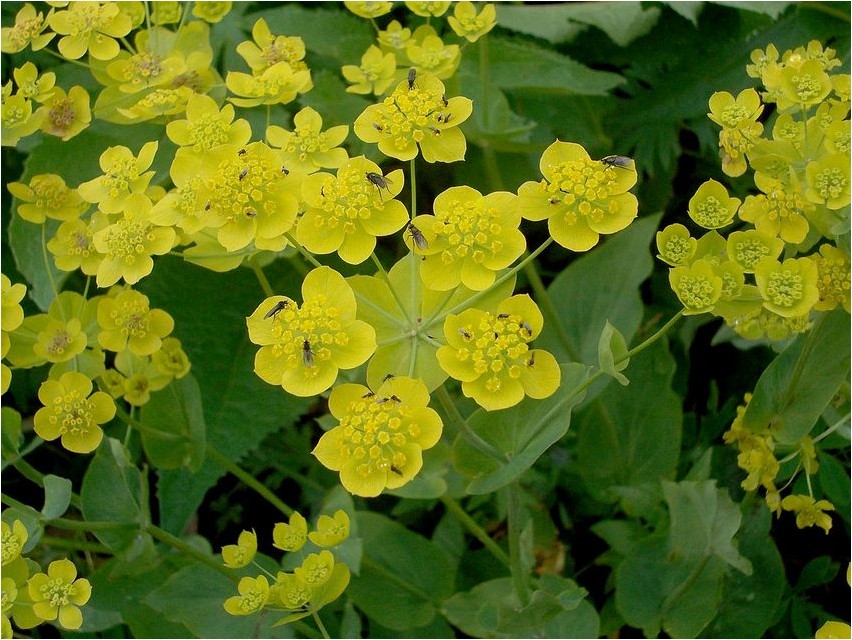
Bupleurum multinerve DC is one of the plants of the family called Umbellaceae; in Latin the name of this plant will be as follows: Bupleurum multinerve DC.
As for the name of the family itself, in Latin it will be: Apiaceae Lindl.
Description of the multi-veined vein
The multi-veined grass is a perennial herbaceous plant, the height of which can vary between ten and seventy centimeters. This plant will have about two or three such stems, however, sometimes the stems are single. Among other things, the stems are straight, relatively sinuous, they can be either straight or branched at the top. The basal and lower stem leaves will be either petal-lanceolate or lanceolate; towards the base, the leaves gradually narrow into a rather long petiole.
The middle and upper stem leaves are several times shorter than the lower leaves, they are long-pointed or lanceolate in shape, these leaves are sessile, in the lower part they are ovate expanded to about one or two centimeters, and their base will be heart-shaped and stem-encompassing. The umbrella contains about twenty to thirty flowers, which are located on rather long stalks. The petals and sub-pillars will be yellow in color, and the fruits will be elliptical in shape, and the color of such fruits will be dark brown. The length of the fruit will be about three to four millimeters.
This plant has become widespread in Western and Eastern Siberia, as well as in Central Asia and the European part of Russia, namely in the Volga-Don and Volga-Kama regions. For growth, this plant prefers rocky slopes, shrubs, forest edges, steppe and subalpine meadows. Flowering of the multi-veined plant occurs in the period from June to July, with the fruits ripening approximately in July-August.
Description of the medicinal properties of the multi-veined beetroot
For medicinal purposes, it is recommended to use flowers, fruits, roots, as well as the grass of this plant. The following polyacetylene compounds were found in the roots of the multivein plant: narcissin, quercetin, isorhamnetin and isoquercitrin. At the same time, the leaves, fruits and stems of this plant contain quercetin, rutin, isorhamnetin, isoquercitrin, narcissin, as well as some higher aliphatic alcohols and ketones. The leaves of the multiveined plant contain carotene and vitamin C and carotene.

The flavonoids contained in this plant are capable of normalizing pathologically increased capillary permeability, and are also endowed with quite pronounced antihyaluronidase activity.
A decoction prepared from the roots of this plant is recommended for use for inflammation of the upper respiratory tract, as well as for cholecystitis, cholelithiasis and menstrual irregularities. In Mongolian medicine, an infusion prepared from flowers and fruits became quite widespread for gastrointestinal diseases, and also as an anthelmintic. As for China, here a preparation from the roots of the multifilamentum is used for intramuscular injections in cases of inflammation of the upper respiratory tract.
For gallstone disease, it is recommended to use the following remedy: to prepare it, take fifteen grams of crushed dry roots per about three hundred milliliters of water. The resulting mixture should be boiled over fairly low heat for six to eight minutes, and then infused for one hour, after which it is carefully filtered. This remedy is taken three times a day, one hundred milliliters before meals.





