Walnut
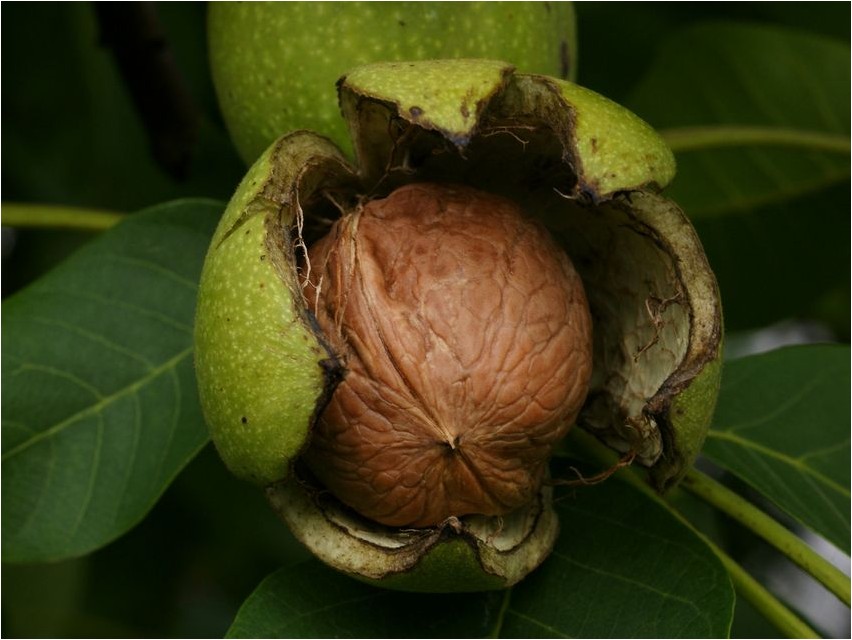
Walnut (lat. Juglans regia) is a type of tree from the large walnut family.
Description
The walnut is a fairly large tree, capable of reaching twenty-five meters in height. And the trunks of this tree sometimes reach three to seven meters in diameter. All trunks are covered with dense grayish bark, and walnut branches always form lush crowns.
The odd-pinnate and complex, intricate alternate leaves of the plant consist of elongated ovate leaves (of two or five pairs). They bloom at the same time as the flowers and reach a length of 40 to 70 mm.
Greenish small flowers are always dioecious. The staminate flowers, collected in hanging earrings, are formed by twelve to eighteen stamens and perianths with six lobes. And sessile pistillate flowers are endowed with double perianths fused with the formed ovaries. They are located on the tops of annual branches in small groups (two or three flowers) or singly.
The fruits of this plant have the appearance of fairly large single-seeded drupes, covered with rather thick green leathery-fibrous peels, which are called pericarps. And the strong spherical or ovoid seeds (that is, the nuts themselves) are equipped with incomplete partitions in the amount of two to five pieces. As soon as the fruits ripen, the peels on them immediately dry out and burst, revealing woody shells, inside of which edible kernels are hidden.
Walnut blossoms can be observed in May, at the same time as the leaves bloom. Sometimes it happens that trees bloom again in June. And the fruits ripen in September-October. All fruits differ quite strongly in a number of indicators. As a rule, one nut weighs from five to seventeen grams, and the kernels account for from 40 to 58% of the total mass.

The renewal of this crop occurs either vegetatively or by seed. Before the tiny seedlings reach a year old, powerful taproots form on them, reaching one and a half meters in length by the age of five, and three and a half by the age of twenty. And after 3 — 5 years, horizontal roots are formed, most of which deepen by twenty to fifty centimeters.
Spreading
Walnuts can be found in the wild in Transcaucasia. In addition, this crop grows well in Iran, the Tien Shan, northern India and far northern China, as well as in sunny Greece and Asia Minor. And in Western Europe, this plant is still considered wild.
Growing and care
Walnut thrives in moderately moist, humus-enriched soils with good aeration. And lime-rich substrates are generally a real boon for these trees. When growing walnuts, it is important to take into account that this crop needs very substantial volumes of soil, since its roots often go four meters deep and about twenty meters to the sides. By the way, this feature allows the trees to easily endure periods of drought.
But the vulnerable walnut, alas, cannot withstand severe frosts — if the thermometer drops below twenty-five to twenty-eight degrees, the trees begin to freeze.
Since the walnut is very unpretentious, it does not require any special care. Until the trees begin to actively bear fruit, you can grow various vegetable crops in the inter-row spaces. By the way, the walnut begins to bear fruit only in the seventh or eighth year of its existence. But then he does not lose this ability until the very end of his life. And the yield of this crop can sometimes reach twenty-five to thirty centners per hectare.





