Grinderia splayed
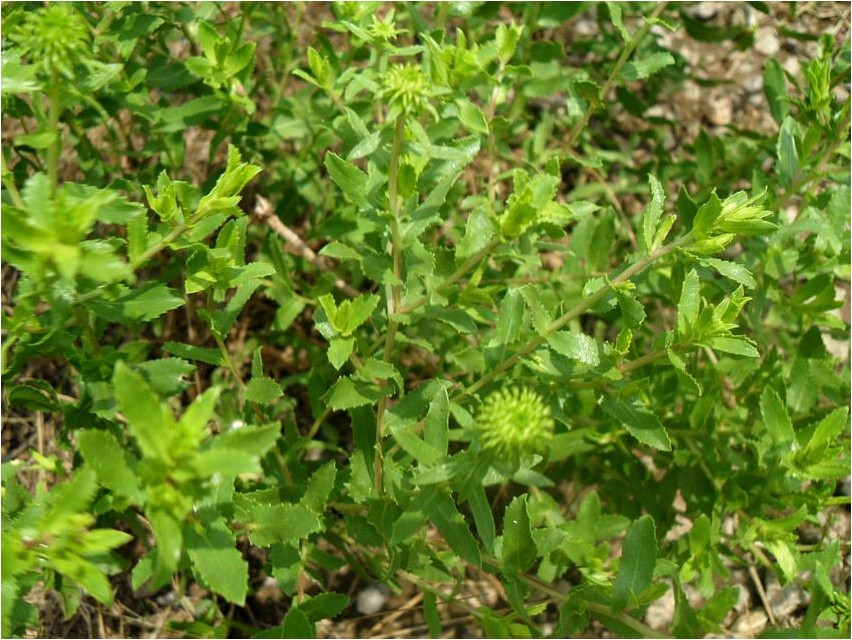
Grinderia prostrata is one of the plants of the family called Asteraceae or Asteraceae; in Latin the name of this plant will be as follows: Grindelia squarrosa (Pursh.) Dun.
As for the name of the family of Grinderia prostrate, in Latin it will be like this: Asteraceae Dumort.
Description of Grinderia splayed
Grinderia prostrata is an annual herbaceous plant whose height will vary between twenty-five and seventy centimeters. The root of this plant is thin and spindle-shaped. The stems will be simple and single, sometimes at the very base they can be branched, and the stems are round in shape. The leaves of Grinderia splayed will be lanceolate, and their length will be five to ten centimeters, with the upper leaves being somewhat shorter. These leaves of this plant are colored in light green tones. The width of the baskets will be about two to three centimeters, and the reed flowers are colored yellow. The achenes are flattened and quite small: their length does not exceed two millimeters. Such achenes of Grinderia splayed are painted in dark brown tones.
This plant blooms from July to October. Under natural conditions, this plant can be found on the territory of the European part of Russia as an alien plant in the Baltic and Black Sea regions, as well as in Moldova and the Dnieper region of Ukraine. Grinderia prostrata prefers places to grow along ditches and on roadsides. It is noteworthy that this plant is an insecticide.
Description of the medicinal properties of Grinderia prostrate
Grinderia prostrata is endowed with quite valuable healing properties, and it is recommended to use the roots, stems and grass of this plant for medicinal purposes. The presence of such valuable healing properties is explained by the content of essential oil, phenolcarboxylic acids, flavonoids and diterpenoids in the plant. It is noteworthy that this plant has the ability to exhibit antibacterial activity.
A decoction and infusion prepared from the herb of this plant is recommended for use in stomach cancer, and also as an expectorant, sedative and antispasmodic. The tincture is used as a detoxifying agent and externally for dermatitis. As for North America, here both a decoction and an infusion of grindelia spread is used to treat diseases of the kidneys, bladder, gynecological diseases, syphilis, and pulmonary tuberculosis. And also as an expectorant for coughs and stomach colic in children. Moreover, as a poultice, this remedy is effective for fractures and tumors, the juice is used for eye diseases, and for wounds, this remedy can be used as a disinfectant rinse. A decoction of the roots of grindelia splayed is used for coughs and various liver diseases. A decoction of the stems of this plant is used for pneumonia and as an expectorant. A decoction of the herb is used for skin diseases. In veterinary medicine, products based on Grindelia prostrata are used to wash both wounds and saddle abrasions in horses.

For pulmonary tuberculosis, for diseases of the kidneys and bladder, and also as a sedative, expectorant and antispasmodic, the following is recommended: to prepare such a remedy, you will need to take one tablespoon of grindelia grass spread in one glass of water. The resulting mixture is boiled for two to three minutes, and then left to infuse for one hour, after which this mixture based on grindelia splayed is carefully filtered. It is recommended to take one tablespoon three to four times a day.





