Greek obvoynik
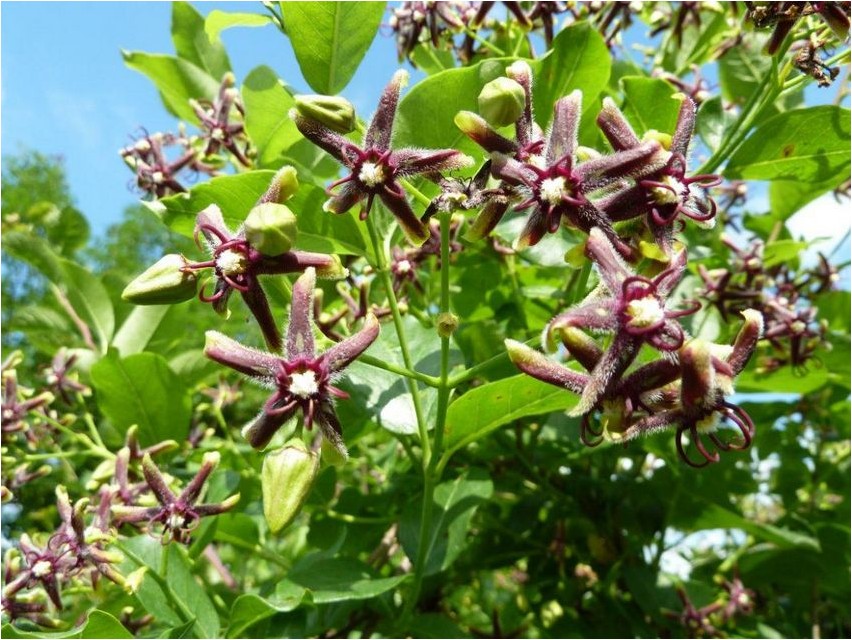
The Greek plant is one of the plants of the family called the swallowwort family; in Latin the name of this plant will be as follows: Periploca graeca L.
As for the name of the Greek rose family itself, in Latin it will be: Asclepiadaceae R. Br.
Description of the Greek obvoynik
Greek obvoynik is a climbing shrub that will twine around trees, and its length will fluctuate between ten and thirty meters. The bark of this plant is colored red-brown. The leaves of the Greek plant are opposite, short-petiolate, simple, entire and pointed; in shape, such leaves can be either ovate or oval-oblong. The inflorescences of this plant are sparse semi-umbrellas. The flowers of the Greek plant can be colored either greenish-violet or greenish-brown. The fruit of this plant is a multi-seeded complex leaflet.
Under natural conditions, this plant is found in the oak-hornbeam forests of the Black Sea coast, and will also be cultivated in Central Asia and Moldova. For its growth, the Greek cucumber prefers bushes, valley forests and coastal alder forests. It should be noted that as an ornamental vine, this plant will be actively cultivated in gardens and parks. It is important to remember that the Greek plant is a poisonous plant.
Description of the medicinal properties of Greek obvoynik
The Greek plant is endowed with very valuable healing properties, and it is recommended to use the branches and bark of this plant for medicinal purposes. Such medicinal raw materials should be collected in early spring, from April to May.
The presence of such valuable healing properties should be explained by the content of rubber in the composition of this plant, while the branches of the Greek plant contain the flavonoid quercetin glycoside, ursolic acid, periplocin cardenolide, as well as phenolcarboxylic acids and their derivatives. The bark contains coumarins, periplocin and phenols. The leaves will contain flavonoids, leukocyanidin, leukoanthocyanin, flavonoids, phenolcarboxylic acids and their derivatives.

A tincture prepared from the bark of this plant has a very effective diuretic effect, and will also increase the strength of heart contractions, reduce shortness of breath and accelerate blood flow. A decoction based on the branches of the Greek plant is used for hemorrhoids and pulmonary tuberculosis. The leaves of this plant are also endowed with bactericidal activity, while the seeds will be endowed with cardiotonic effects.
As for veterinary medicine, bark tincture is used for circulatory disorders and cardiovascular weakness. In the Caucasus, the juice of the Greek honey was used as poison for wolves. It should be remembered that due to the fact that the Greek rose is a poisonous plant, for this reason it is recommended to exercise extreme caution when handling this plant.
For pulmonary tuberculosis, it is recommended to use the following remedy based on this plant: to prepare such a healing remedy, you will need to take one tablespoon of crushed branches per half liter of water. The resulting healing mixture should be boiled for five minutes, then this mixture is left to infuse for one hour, after which this mixture is filtered very carefully. Take the resulting product three times a day, one tablespoon. When used correctly, such a healing remedy based on the Greek plant turns out to be very effective.





