Cherry laurel
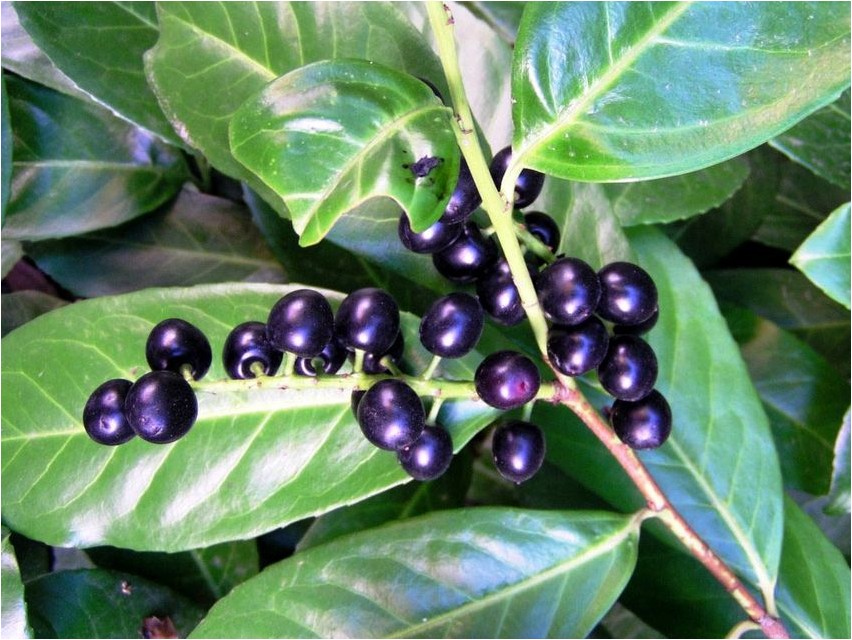
Cherry laurel is one of the plants of the family called Rosaceae; in Latin the name of this plant will be as follows: Laurocerasum officinalis M. Rocm. (Primus laurocerasus L.).
As for the name of the cherry laurel family itself, in Latin it will be: Rosaceae Juss.
Description of cherry laurel
Cherry laurel is an evergreen tree whose height will vary between eight and ten meters, and sometimes such a plant can grow in a bushy manner. The bark on the trunks of this plant will be rough, and it is painted in dark gray tones. The leaves of cherry laurel are alternate and oblong-elliptical in shape; the length of such leaves will be about five to twenty centimeters, and the width will be four to six centimeters. Such leaves will be leathery, shiny on top and matte below, the leaves are painted in dark green tones. At the base of the main vein of the leaves of cherry laurel there will be about two to four glands, which are located on petioles about half a centimeter to one centimeter long. The flowers of this plant are quite small, fragrant, quintuple type and they are painted white. Such flowers are collected in dense axillary racemes, the length of which will vary between five and thirteen centimeters.
The sepals of cherry laurel will be small and triangular in shape, the length of the petals reaches three millimeters, such sepals are also obovate. There will be quite a few stamens, while there is only one pistil. The ovary of such a plant is superior and unilocular. The fruits of cherry laurel are colored black; they are round-ovoid drupes, endowed with a smooth ovoid stone, the length of which is about eight millimeters.
Cherry laurel blooms from April to May, while the fruits ripen in August. It is noteworthy that the fruits of this plant are endowed with a very sweet taste and aroma. Under natural conditions, this plant is found in Iran, Asia Minor, the Balkans, Ciscaucasia, Western and Eastern Transcaucasia.
Description of the medicinal properties of cherry laurel
Cherry laurel is endowed with very valuable healing properties, and it is recommended to use fresh leaves of this plant for medicinal purposes. It is noteworthy that all parts of the cherry laurel are poisonous, with the only exception being the pulp of the fruits of this plant. For this reason, extreme care should be taken when handling the plant.

The presence of such valuable healing properties should be explained by the content of nitrogen-containing compounds in this plant: tannins, hydrocyanic acid and its derivatives. Cherry laurel wood contains gum, which will contain the following carbohydrates in the hydrolyzate: rhamnose, xylose, galactose and arabinose. Hydrocyanic acid and its derivatives were found in the buds of this plant. The leaves will contain very valuable essential oil, nitrogen-containing compounds, tannins, catechins and phenolcarboxylic acids.
The leaves should be plucked from the plant around July-August, and then they are steam distilled, resulting in the so-called cherry laurel oil, which in smell and taste will resemble bitter almond water. This remedy is effective for coughs, heart and lung diseases, and also for disorders of the nervous system.





