Cassia angustifolia
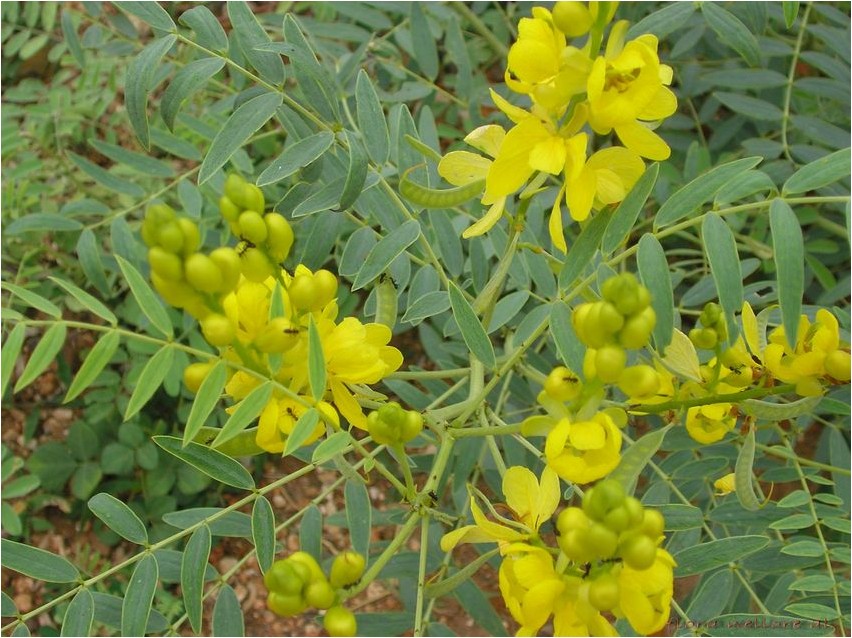
Cassia angustifolia is a member of the Caesalpiniaceae family, and its Latin name is Cassia angustifolia Vaahl.
The family name itself is Caesalpinaceae R. Br.
Description of Cassia angustifolia
Cassia angustifolia is also known as Indian senna. Cassia angustifolia is a perennial tropical subshrub that can reach two meters in height. The plant has a sparsely branched taproot that extends deeply into the soil. The stem of Cassia angustifolia is branched and erect, and bears alternate, compound, paripinnate leaves with four to eight pairs of narrow, acute, and ovate-lanceolate leaflets. The leaves of this plant are pointed and entire, tapering at the apex, with short petioles and leathery texture. The flowers are slightly irregular and large, gathered in axillary racemes and golden-yellow in color. The fruit of Cassia angustifolia is a flat, multi-family legume, reaching five and a half centimeters in length and two and a half centimeters in width. This fruit is dark brown in color.
Cassia angustifolia grows in Africa and Arabia, in the region of East Africa and the Red Sea. This plant is cultivated in India, the Krasnodar Territory, Uzbekistan, Azerbaijan, Tajikistan, and Turkmenistan.
Description of the medicinal properties of Cassia angustifolia
Cassia angustifolia has very valuable medicinal properties, and it is recommended to use the paripinnate leaflets for medicinal purposes. The leaves should be harvested when a yellowish tint appears on the lowermost leaves. The leaves, stems, and fruits of this plant contain anthraglycosides, annoside A, sennoside B, and also anthra derivatives: traces of alkaloids, resins, emodin, flavonoids, as well as palmitic, linoleic, stearic, chrysophanic, palmitic, and other organic acids. It should be noted that this plant also contains mercuric alcohol.
The leaves of this plant have laxative properties and are able to improve intestinal motility. It is important to remember that with long-term use, the plant will not have a toxic effect on the body, nor will it cause constipation, acting slowly, painlessly, and gently.

It should be noted that Cassia angustifolia leaf is the main remedy that should be used as a laxative. This plant is effective for habitual and chronic constipation, for hemorrhoids and anal fissures, for diseases of the gallbladder and liver, as well as before surgery and for postoperative intestinal atony. It should be noted that with prolonged use of a product based on this plant, addiction and weakening of the therapeutic effect are noted. For this reason, this remedy should be used alternately with other means. It is also important to remember that laxatives containing anthraglycosides are not allowed for use during pregnancy and lactation. Such contraindications should be related to the fact that these products based on Cassia angustifolia can cause abortion, and will also be supplied with mother’s milk in toxic concentrations for the child.
As for Chinese medicine, the leaves of this plant are used in small doses to improve digestion and appetite, and in large doses they are used for edema, glaucoma and as a laxative. Externally, such products are used for various skin diseases, pyoderma and conjunctivitis.
Cassia angustifolia, Senna or Alexandria leaf
https://www. youtube. com/watch? v=C3c1uIpY5X4
Cassia angustifolia cassia