Sapota black
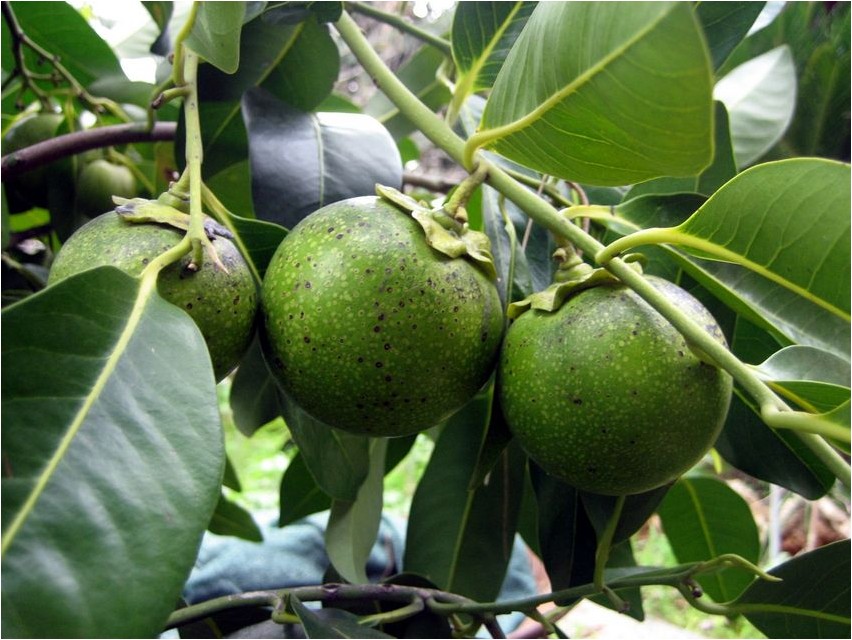
Black sapota (lat. Diospyros digyna) is a fruit plant representing the Ebony family and is the closest relative of persimmon.
Other names are black apple, as well as chocolate or black persimmon. In general, this culture has a great variety of names in a wide variety of languages.
Description
Black sapota is an evergreen, slow-flowering tree with a surprisingly beautiful crown. Its trunks are covered with spectacular black bark, and its height can reach twenty-five meters.
The leathery leaves of black sapota, pointed at the tips, are always glossy and characterized by an oblong-lanceolate shape, and their length ranges from ten to thirty centimeters.
The white flowers of the plant are equipped with green cups and reach a diameter of about 1 — 1. 6 cm. They also boast a subtle gardenia aroma.
The fruits of black sapota are always spherical in shape. Unripe fruits are usually shiny and bright green, but as they ripen they first turn brownish-greenish in color and then turn dirty green. The diameter of the fruits reaches from five to twelve and a half centimeters. And on top, each fruit is carefully covered with wavy cups, the diameter of which varies from four to five centimeters. In general, the appearance of these fruits, to put it mildly, is not very presentable — from the outside they look very much like rotten apples. However, the first impression in this case is very deceptive! In order to fall in love with these fruits, you only need to try them at least once!

The pulp inside the fruit is very tender and glossy, usually black-brown, but sometimes it can be completely black. It is characterized by a faint pleasant odor, a sweet taste (somewhat similar to chocolate pudding) and a jelly-like consistency. And inside the pulp you can find from one to ten brownish flat seeds, the length of which is two to two and a half centimeters. However, sometimes you can come across completely seedless fruits.
Where does it grow
The homeland of black sapota is the southern Mexican and Guatemalan lowlands. It is mainly grown there. In addition, plantings of black sapota can be found in the Philippines, Hawaii, the picturesque Antilles, as well as in distant Mauritius and sunny Brazil.
Application
Black sapote pulp is usually eaten fresh. It”s also often used as a filling for various confectionery products or as a pie filling. It”s also often fermented into alcoholic beverages and added to cocktails or ice cream.
Despite the fact that black sapote contains no more than 140 calories, it”s considered an incredibly nutritious food. These fruits are an excellent general tonic, helping to prevent and treat various cardiovascular and respiratory ailments. Regular consumption can strengthen the immune system, teeth, and bones, as well as increase hemoglobin levels. Black sapote also significantly promotes weight loss. Black sapote”s rich potassium content makes it an indispensable remedy for a wide variety of cardiovascular conditions—it”s especially beneficial for dropsy, cardiac edema, hypertension, and more. Potassium also has a beneficial effect on the nervous system.
Crushed leaves and bark are used in poultices for leprosy, ringworm, and a variety of other skin ailments. A decoction made from the leaves is also an excellent antipyretic, as well as astringent and astringent.
Contraindications
The abundance of sugars in black sapote makes it a completely unsuitable option for diabetics. Furthermore, these fruits contain substances that can trigger allergies.
Black Sapote (Chocolate Pudding Fruit)