carrots
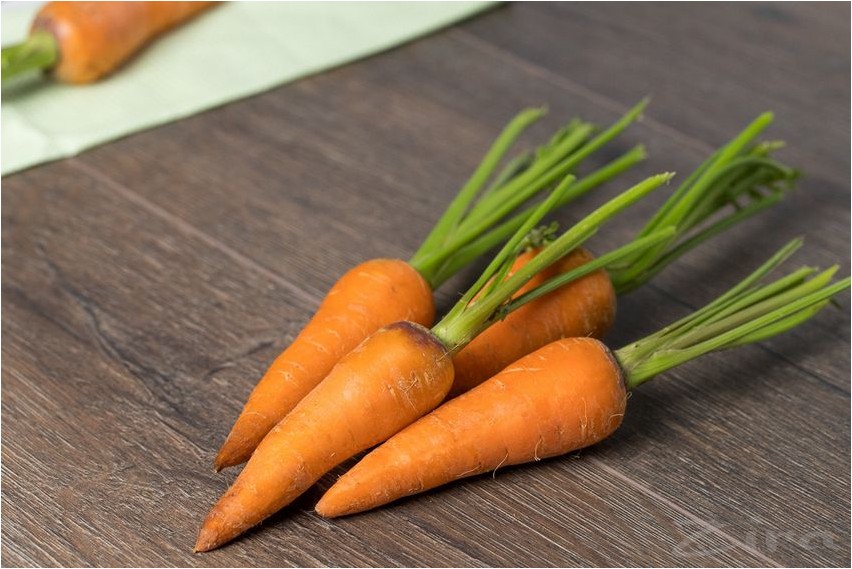
Carrots (lat. Daucus) are a popular vegetable crop, a biennial plant with a rough, woody root that is orange or yellowish-white in color.
Characteristics of culture
Carrots are a plant that forms a root crop and a rosette of leaves in the first year, and a seed bush and seeds in the second year. The root crop is spindle-shaped, oval, cylindrical or truncated-conical in shape, fleshy, thickened, weighing from 30 to 300 g, formed due to the deposits of nutrients, inside there is a core, the diameter of which does not exceed 30-40% of the total thickness. The root system is taprooted, fast-growing, the roots reach a depth of 1. 5-2 m, the bulk of which is located at a depth of 50-60 cm.
The leaves of carrots of the first year of life are collected in a rosette and can be dissected-pinnate, triangular, pubescent or glabrous. The leaves of the second year are located on petioles that widen at the stem. The inflorescences are presented in the form of complex umbrellas, multi-rayed, flat or convex during flowering, and compressed over time. The petals are ovoid, white, cream, pink or purple.
The fruit is a two-seed, usually oval or oblong in shape, slightly compressed on the reverse side, with two rows of sharp bristles or awl-like spines on the ribs. The most valuable seeds are considered to be those collected from the central umbrellas.
Growing conditions

Carrots are a cold-resistant plant, the optimal temperature for seed germination is 8-10C, however, at higher air temperatures, seedlings appear faster. The culture can withstand frosts down t o-4 C. The plant is quite demanding of sunlight and does not tolerate shaded areas well. The growth and development of plantings is negatively affected by dense plantings, especially in the first phase, the plants become elongated, and the yield and vitamin value are significantly reduced.
Carrots are relatively drought-resistant; the presence of essential oils in the leaves prevents excessive evaporation of moisture. Requires abundant watering during seed germination and the first phase of growth. Irrigation and timely watering significantly affect the quantity and quality of the crop. Sharp transitions from dryness to moisture negatively affect the quality of root crops.
The soil for growing carrots should be fairly loose, light loamy or sandy loam with a high humus content and a neutral or slightly acidic pH. Clayey or heavy loamy soils, structureless or acidic soils are unsuitable. Ideal predecessors for carrots include legumes, cabbage, early potatoes, cucumbers, tomatoes, and onions. It is not recommended to plant carrots after parsley, dill, celery, or parsnips.
Planting
Before sowing, treat the seeds with a weak solution of potassium permanganate. To accelerate germination, place the seeds on a damp piece of cloth, wrap it, and keep it at a temperature of 20-22°C (68-72°F) for several days. Care must be taken to keep the cloth moist at all times, otherwise the seeds will not germinate. Before planting in open ground, dig shallow furrows in the garden bed; the optimal depth is 2-3 cm. The distance between furrows should be at least 15-20 cm. After sowing, cover the seeds with a layer of soil and water thoroughly.
Care
Carrots require regular weeding. Weeds are detrimental to the crop”s development, especially in the early stages of growth. Therefore, they should be removed immediately after they appear, removing them along with the roots. Compacted soil is also undesirable, as it causes the roots to become crooked. To prevent this, loosening the soil is recommended.
Once the seedlings emerge, thin the carrots; the distance between plants should be approximately 3-4 cm. If the seeds were sown sparsely, thinning is not necessary. Water the crop daily; lack of moisture will affect the taste of the roots. Carrots also require fertilizing. The first fertilizing is done 3-4 weeks after emergence, and the second after 1. 5-2 months. Fertilizers that can be used include nitrophoska, wood ash, potassium nitrate, superphosphate, and urea.
Pest and disease control are essential for a good harvest. The main enemy of root vegetables is the carrot fly, which most often appears in dense plantings and overly wet beds. To combat carrot fly, use Actellic, Intavir, or other chemicals. Less commonly, the crop is susceptible to diseases such as phoma or alternaria; a 1% solution of Bordeaux mixture can be used for preventative treatment.
EXTREME BITE, LICK, or NOTHING CHALLENGE!
Carrots