Artemisia sieversiana
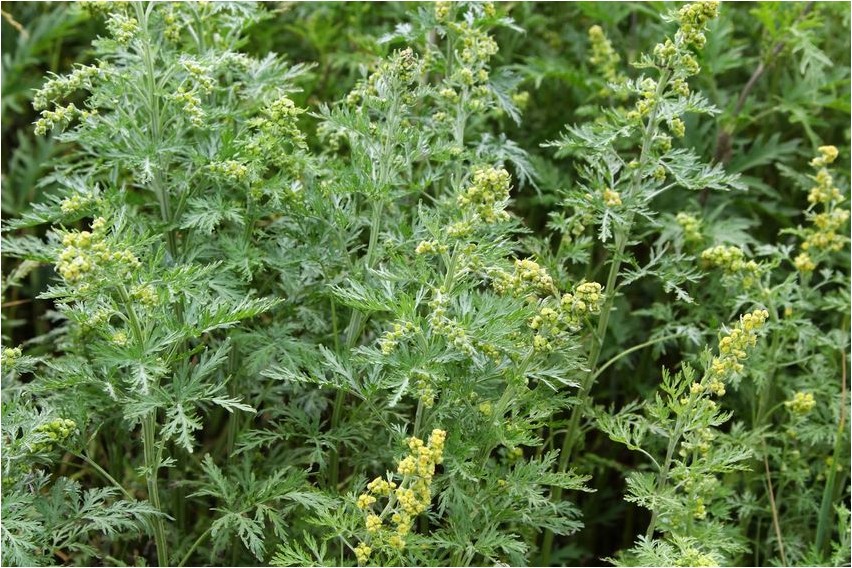
Artemisia sieversiana is a member of the Asteraceae or Compositae family. Its Latin name is Artemisia sieversiana Willd.
As for the family name itself, the Latin name is Asteraceae Dumort. (Compositae Giseke).
Description of Artemisia sieversiana
Artemisia sieversiana is a herbaceous annual or biennial plant, whitish or grayish in color due to dense, recumbent hairs. It also has a vertical, thin rootstock. The stem of Artemisia sieversiana is branched, straight, and ribbed, and its height ranges from thirty to one hundred centimeters. The leaves of this plant are pitted, with the lower and middle stem leaves having long petioles, ranging from one and a half to twelve centimeters in length. The leaf blades of Artemisia sieversii are broadly angular in outline, and thrice or twice pinnately dissected into linear-oblong or oblong, obtuse, and twisted lobes. These lobes are approximately two to ten millimeters long and approximately two millimeters wide. The upper leaves and bracts of this plant are less complex and sessile, with the uppermost leaves being entire and linear. The flower heads of Artemisia sieversii are hemispherical and quite numerous, approximately four to six millimeters wide, and are borne in a broad paniculate inflorescence. The outer leaflets of this plant are linear-oblong and hairy, while the inner leaflets are suborbicular or elliptical in shape. The red flowers are pistillate, with only eighteen of them. The corolla itself is narrowly toothed, gradually widening toward the base. The flowers of Artemisia sieversiana are bisexual and quite numerous. The corolla itself is glabrous and conical, and the anthers are oblong-lanceolate. The achenes of this plant are ovoid, grooved, almost flat, and quite thin, with a rounded, flattened surface at the apex.
Artemisia sieversiana blooms in August. In the wild, this plant is found in Central Asia, the Far East, Western and Eastern Siberia, as well as the following regions of the European part of Russia: Kama, Volga, and Trans-Volga. Description of the medicinal properties of Artemisia sieversii
Sievers wormwood is endowed with very valuable healing properties, and it is recommended to use the roots and herbs of this plant for medicinal purposes. The term grass includes flowers, stems and leaves. The presence of such valuable healing properties should be explained by the content of ascorbic acid, organic acids, coumarins, flavonoids, carotene and gamma-lactone in this plant. It should be noted that the essential oil will contain sesquiterpene alcohols.
Infusions and decoctions prepared from the inflorescences, roots and herbs of this plant are used in both folk and Tibetan medicine for bronchitis and cough. An infusion based on the herb wormwood sievers is used as a diaphoretic for fever and colds. This plant has the ability to improve appetite and activity of the gastrointestinal tract, and also wormwood sievers can be used as an anthelmintic and is successfully used for constipation.
An infusion based on the herb of this plant is used as a painkiller: this remedy is used for rheumatism, headaches, stomach colic, gastralgia, menstrual irregularities and various sexually transmitted diseases.

WORMWORM \ Useful medicinal properties \ Collection rules \ Nuances of harvesting \ Pharmacy under your feet


