Stevia
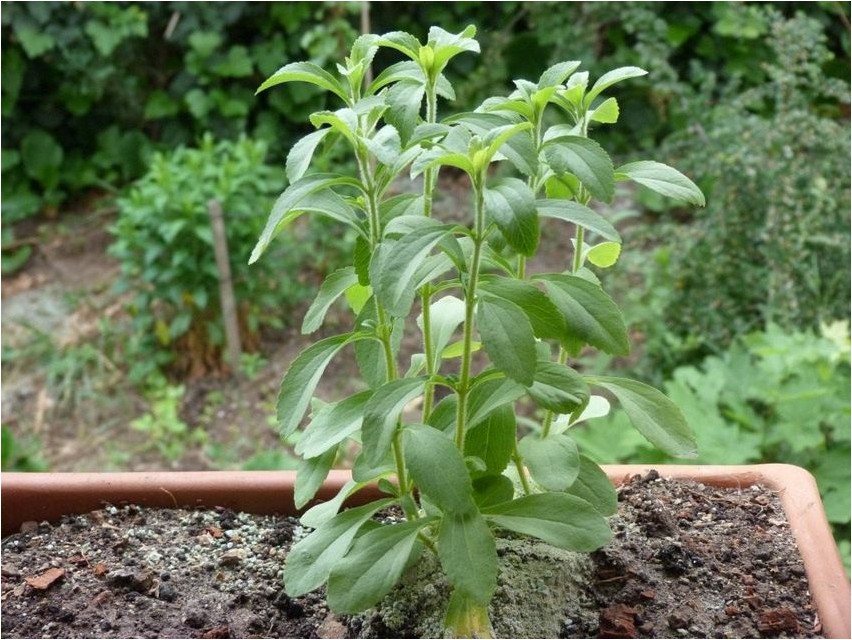
Stevia (lat. Stevia) is a genus of perennial herbs and shrubs of the Compositae, or Asteraceae, family. Includes about 150 species.
Natural range: Central and South America. Typical habitats are plains, slopes and mountainous areas.
Characteristics of culture
Stevia is a herbaceous plant, subshrub or shrub up to 80 cm high. There are numerous lateral stems. The root system is powerful, fibrous, highly branched. The leaves are simple, paired, oval, pubescent on both sides. The flowers are small, white in color. The culture has been known since ancient times and has been used for food and as a medicinal plant for several thousand years.
Other names are honey grass or sweet grass. Stevia was introduced into cultivation in 1887. The plants contain a complex substance called stevioside, which is why the leaves have a sweet taste. Stevia also contains sucrose, glucose and steviol. It is an alternative to sugar, but more healthy and suitable for diabetics and obese people.
Subtleties of cultivation and reproduction
Stevia comes from southern countries, so sunny areas protected from drafts and wind are preferred for its cultivation. The optimal temperature for growth and development is 22-28C. The soils are desirable: light, loose, slightly acidic, sandy or sandy loam. Heavy clay substrates are not suitable, but with good drainage, growing crops on such soils is possible. Stevia does not accept peat soils; it feels depressed on them. Calcareous soils are also contraindicated.
Stevia is propagated by seeds, dividing the bush and cuttings. In Russia, stevia is grown as an annual plant using seedlings. Sowing is carried out at the end of March in seedling containers filled with nutrient soil with the addition of sand and humus. The seeds are sown without planting, after which they are well moistened and covered with glass or plastic film.

With the emergence of seedlings, the glass or film is removed, and the seedlings are placed on a windowsill or other intensely lit place. The seedlings are picked when two true leaves appear on them. The seedlings are systematically watered and fed weekly with complex mineral fertilizers.
Seedlings are planted in the ground at the end of May. The distance between plants should be at least 25 cm. The depth of the planting hole is 6-7 cm. After planting, water with warm, settled water and mulch the rows. Further care comes down to frequent watering and fertilizing (once every two weeks). Weeding and loosening are required.
Application
Stevia is a healthy and safe product; today the plant is used in cooking and folk medicine. Stevia is used in salads, marinades, soft drinks, candies, chewing gum, confectionery, yogurt, tea and even soy sauce.
As a medicine, stevia has a number of miraculous properties. It copes with many ailments, for example, diseases of the gastrointestinal tract, hypertension, allergies of various types, bronchitis, gout, asthma, kidney diseases, psoriasis and depression.