Hellebore blushing
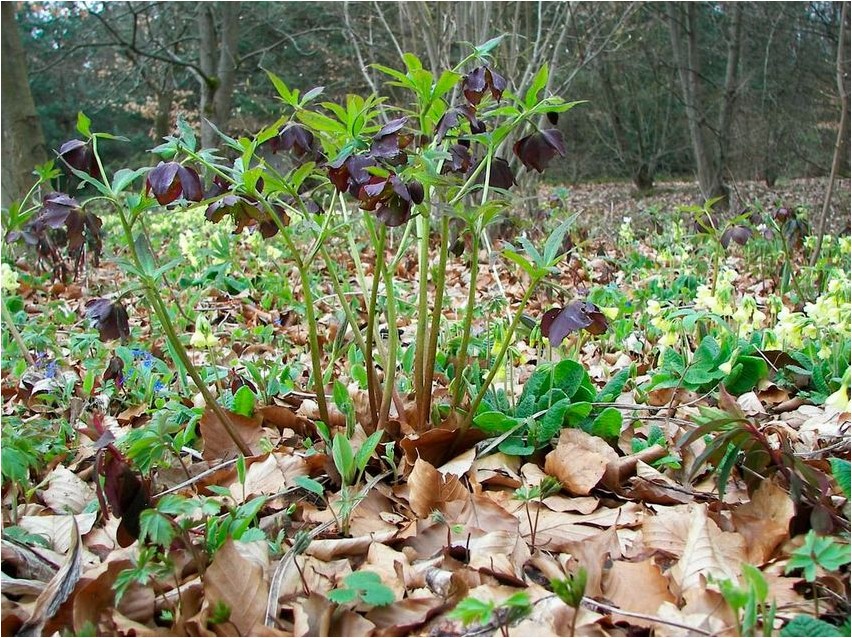
Hellebore blushing is one of the plants of the family called Ranunculaceae; in Latin the name of this plant will be as follows: Helleborus purpurescens Waldst. et Kit.
As for the name of the blushing hellebore family itself, in Latin it will be: Ranunculaceae Juss.
Description of hellebore blushing
Hellebore blushing is a perennial evergreen herbaceous plant whose height will vary between two and fifty centimeters. The rhizome of this plant is quite thick, and its diameter can reach up to ten centimeters; such a rhizome will be horizontal, short, it is endowed with numerous long and cord-like roots, which in turn are painted in dark brown tones, like the rhizome itself. The stems of hellebore blushing are simple and leafless, at the top they will be weakly branched and also short pubescent, they are endowed with one to three flowers, which are apical, drooping and large. Such flowers are painted in pale purple or off-white tones, at the base they are yellow-green, and on the outside they will be reddish. The leaves of hellebore blushing are basal and numerous, their length is twenty to thirty centimeters, they will be long-petioled, and also endowed with an almost leathery and shiny palmately dissected plate into five to seven segments, which will be pubescent along the veins below. The fruits of this plant are assembled leaflets that will be fused at the base, and their length will be about fifteen to twenty centimeters. The seeds of this plant are black in color, they will be numerous and keeled-elliptical.
The flowering of the red hellebore occurs in the period from March to April, while the ripening of the fruits will occur in May-June. Under natural conditions, this plant is found in Transcarpathia, in the Carpathians, in the middle part of the Dniester basin and in southwestern Ukraine. For growth, this plant prefers forest edges, mountain slopes, open sunny meadows, sparse broad-leaved forests, river valleys, rocky screes, and rich soils.
Description of the medicinal properties of hellebore blushing
Hellebore blushing is endowed with very valuable healing properties, and for medicinal purposes it is recommended to use the rhizome and roots of this plant, and sometimes also the leaves. It is noteworthy that the blushing hellebore is a poisonous plant, for this reason it is so important to exercise strict caution when preparing raw materials and in any handling of this plant.
The presence of such valuable healing properties should be explained by the content of the glycoside corelborin and other cardiac glycosides in the roots and rhizomes of this plant.

It is noteworthy that in terms of the speed of action, the glycosides of hellebore blushing turn out to be very close to the glycosides of strophanthus, and in terms of the duration of action, preparations based on this plant turn out to be very similar to digitalis. Such drugs will also be similar to digitalis due to their ability to accumulate in the body.
It should be noted that when used topically, preparations based on this plant will irritate the tissues. It is important to remember the fact that such a strong local irritant effect will have the ability to cause both diarrhea and vomiting. As for traditional medicine, the roots of this plant were widely used here, which were used as a fairly effective laxative based on hellebore blushing.





