Broadleaf cattail
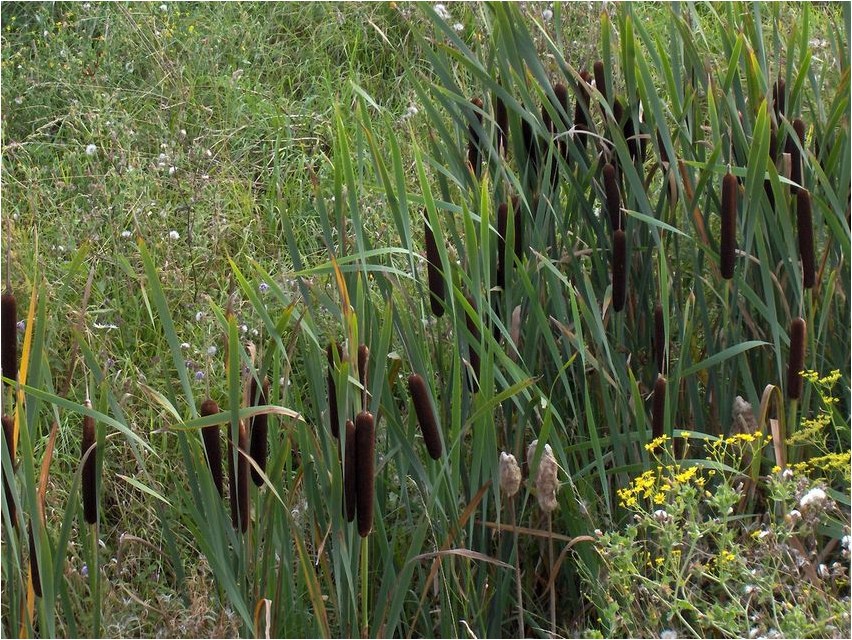
Broadleaf cattail is one of the plants of the family called Cataceae; in Latin the name of this plant will be as follows: Typha latifolia L.
As for the name of the broadleaf cattail family itself, in Latin it will be: Typhaceae.
Description of broadleaf cattail
Broadleaf cattail is a perennial herbaceous plant endowed with a thick branched rhizome, the height of which will be about eighty centimeters – two meters. The stem of this plant is straight and will be endowed with rather long, broadly linear leaves. Broadleaf cattail flowers will be very small in size, they are unisexual, such flowers are found in a thick velvety cylindrical inflorescence in the form of a cob. Such an ear in the upper part of this inflorescence will be staminate, and in the lower part it is pistillate. The fruit of the broadleaf cattail is a nut that will sit on a rather long stalk.
This plant blooms from June to July. Under natural conditions, broadleaf cattail is found in the Far East, the European part of Russia, Crimea, Ukraine, Siberia and Central Asia. For growth, this plant prefers alder forests, shallow waters, shallows and the banks of ditches, swamps and reservoirs.
Description of the medicinal properties of broadleaf cattail
Broadleaf cattail is endowed with very valuable healing properties, and it is recommended to use the leaves and rhizomes of this plant for medicinal purposes. Leaves should be harvested throughout the entire flowering period, while the roots of broadleaf cattail are recommended to be dug up at the end of the autumn period or at the very beginning of spring.
The presence of such valuable healing properties should be explained by the content of esters, protein and ascorbic acid in the leaves of this plant. The rhizomes contain proteins, microelements, sugars, quite a large amount of starch, as well as other useful substances.

Broadleaf cattail is endowed with very effective bactericidal, antiseptic, hemostatic, anti-inflammatory and wound-healing effects. A decoction prepared from the roots of this plant, as well as an infusion based on the leaves of the broadleaf cattail, is indicated for use in periodontal disease, dysentery, colitis and stomatitis. As for the external use of this plant, in the form of compresses, a decoction of rhizomes and an infusion of leaves is used as a wound-healing and hemostatic agent. The crushed leaves of this plant should be applied to various abrasions, wounds, burns and cuts. It should be noted that fresh rhizomes of this plant are quite widely used in homeopathy.
It is noteworthy that rhizomes and young shoots of broadleaf cattail can be used pickled, boiled and fried. Based on the rhizomes of this plant, they not only make flour, but also bake cakes.
In addition, broadleaf cattail turns out to be very suitable for all kinds of weaving, and is also used as stuffing and packaging material.
For colitis, you should use the following very effective remedy based on this plant: to prepare such a healing remedy, you will need to take twenty grams of crushed roots and rhizomes of broadleaf cattail in about one glass of water. The resulting mixture should be boiled over fairly low heat for ten minutes, left to steep for an hour and strained thoroughly. Take this medicine four times a day, one tablespoon.


