Dolingeria rough
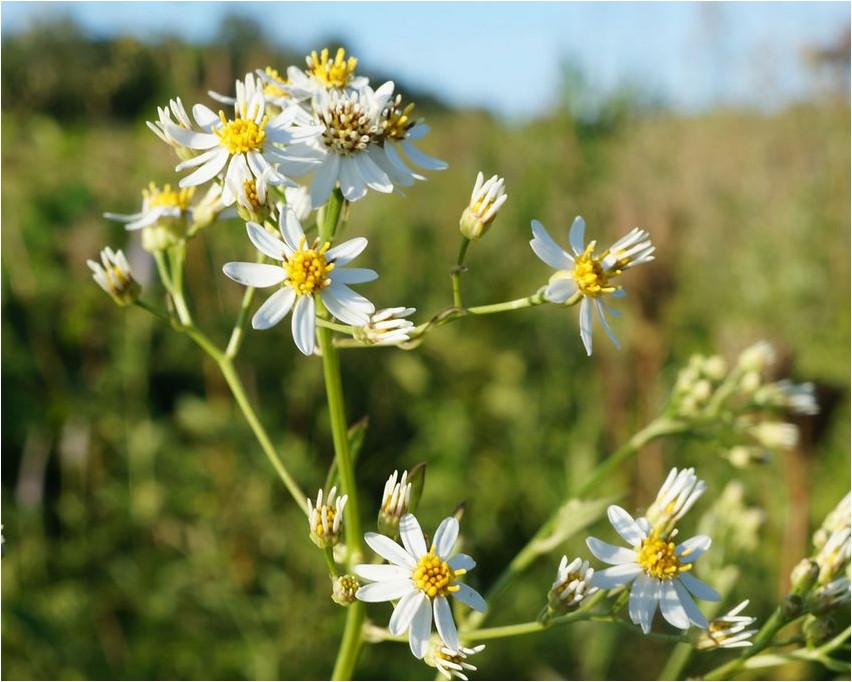
Dollingeria scabra is one of the plants of the family called Asteraceae or Asteraceae; in Latin the name of this plant will be as follows: Doellingeria scabra (Thunb.) Ness.
As for the name of the Dolingeria rough family itself, in Latin it will be like this: Asteraceae Dumort.
Description of Dolingeria rough
Dolingeria roughis is a perennial herbaceous plant, the height of which will fluctuate between fifty and one hundred and fifty centimeters; this plant is endowed with a short thickened rhizome. The stems of Dolingeria rougha are straight, bare and grooved; at the top such stems will be shield-branched, they are curved, slightly pubescent and erect. The basal leaves of this plant are on long petioles and will be heart-shaped. The lower stem leaves of this plant are on even longer petioles; they can be either winged or wingless. The top of the blade of this plant will be colored in green tones, the bottom of the blade will be lighter, and also rough and pubescent on both sides.
The upper leaves of Dolingeria rough will be elongated, they are on short petioles, under the inflorescences they will be linear. The basket is located in a loose shield, on pedicels with bracts; they may be slightly pubescent with leaves, and under the baskets they will be thickened. The corolla of the reed flowers of this plant is white in color, the tubular part will be bare, the disc flowers at the top of this plant will be hairy and the lobes will be slightly recurved. The fruit of Dolingeria roughis is an elongated and oblanceolate achene, which is slightly compressed upward and equipped with one rib, the pappus will be off-white, the numerous setae of this plant are slightly rough and unequal in length.
The flowering of Dolingeria rough occurs from July to September. Under natural conditions, this plant is found in the Ussuri region in the Far East. As for its general distribution, the plant can be seen in Korea, Japan and Northern China.
Description of the medicinal properties of Dolingeria rougha
Dolingeria rough is endowed with quite valuable healing properties, and it is recommended to use the root and herb of this plant for medicinal purposes. The concept of grass includes the flowers, leaves and stems of Dolingeria rough. It is recommended to harvest Dolingeria rough grass in the summer during flowering. It is recommended to cut the grass of this plant, chop it and leave it to dry; in addition, the grass can be used fresh. The roots of this plant should be harvested in the autumn. The plant should be dug up, the root should be washed well in water, the stem should be cut, the root should be cut into separate slices, and then dried.

As for traditional medicine, a decoction of fifteen to thirty grams of the herb of this plant or roots is used for bites of poisonous snakes, as well as for minor injuries, rheumatic pain in the joints. These remedies can also be used for headaches from colds, sore throat, redness and inflammation of the eyes. External use of products based on Dolingeria rougha is also available. To do this, take the fresh herb of this plant, crushed to a mushy state: such raw materials are used as a plaster for various purulent wounds and abscesses, as well as for the bites of poisonous snakes.
It is noteworthy that the healing properties of this plant have not yet been fully studied, for this reason it is quite possible that new remedies based on Dolingeria rougha will emerge in the near future.





